




Why creator acquisition works differently on 4Based
How creator acquisition works in general, which channels exist, how to tell who fits you, what convinces in a first message, is covered in Finding Creators for Your Maloum Agency. That applies on every platform and is not repeated here. This article is only about what genuinely differs on 4Based, and that comes down to three things.
After they say yes, new creators go straight into the 4Based CRM, with their own access for their chatters.
The market is smaller and German-speaking. On a global platform you search a pool of millions and inevitably work with volume. On 4Based you search the DACH region. That sounds like a disadvantage, but in acquisition it is one of the few real advantages: you can actually look at every candidate individually and approach them individually. Volume tactics that work on a platform with millions of users fall flat here, and they stand out negatively, because the scene knows each other.
Almost nobody starts from zero with you. Anyone worth approaching is usually already active somewhere. So you rarely convince someone to become a creator. You convince someone to work on this platform and with you. That is a completely different conversation from classic recruiting, and it fails at different points.
You are selling two things at once. The platform simply has fewer years behind it than the international providers. In every second first conversation you will therefore answer questions about the platform before you get to questions about yourself. If you are not prepared for that, you lose conversations over an objection that has nothing to do with your own work. That is exactly why section 04 exists in this article.
The three groups your creators come from
On 4Based it pays off less to think in channels and more to think in starting positions. That is what decides which argument lands at all, and how much work sits behind a yes.
1. Creators already on 4Based who do everything alone
The fastest group, and the one most often overlooked. These people have already answered the platform question for themselves. It is only about you now. You recognise them by the gaps: irregular posting, long response times, visible pauses. Anyone working alone earns nothing while on holiday, that is not a criticism, it is the normal state of one person running a full-time chat. So the argument that lands here is not "more revenue". It is the same income without the night shift. Come at them with growth promises instead and you are talking past the actual burden.
2. Switchers and parallel operators from larger platforms
This group does the maths, and does it well. They compare numbers, not feelings, and they notice immediately when you do not know your own. The most common mistake is trying to sell them a move. Fans do not migrate as a block, and this group knows that better than you do. What works is proposing a second footing that breaks nothing: keep the existing platform, build 4Based alongside it, shift the German-speaking share over. How to run that cleanly side by side is in 4Based System: Migrate & Run in Parallel.
3. German-speaking creators with no platform experience
The slowest group, and the most loyal. Here you are not a service provider but a way in: you explain the platform, the workflow, the verification, the first few weeks. That creates loyalty, because you genuinely are the reason it works at all. But budget honestly for both: the highest support effort of the three groups and the highest drop-off rate in the first thirty days. Work this group without planning for both and you will eventually write it off as a waste of time, when in fact only the expectation was wrong.
Group 1 costs you conversations, group 2 costs you calculations, group 3 costs you support. Work only one of them and you will either have too few signings or too much work per signing.
The platform itself is your best search field
This is the biggest practical difference to acquisition for other platforms. Scouting on social networks shows you reach and leaves you guessing about everything else. On 4Based you see behaviour, and behaviour tells you far more about whether someone needs support and would accept it.
What to look for:
Consistency rather than volume
Not how much someone publishes, but whether there is a recognisable rhythm behind it. A profile with three posts a week over months is a better signal than one with twenty posts in a week followed by three weeks of silence. How that rhythm holds without eating the day is in 4Based Auto-Posting.
The gaps, not the highlights
Evenings, nights, weekends, public holidays: on a German-speaking platform a large share of revenue happens exactly there, and that is exactly when one person cannot possibly be available. Those gaps are not a flaw to point out, they are the proof that your offer has a use in the first place.
Whether there is any monetisation at all
Some profiles are well maintained and still earn almost nothing, simply because there is no offer behind them. That is the most rewarding case: you do not have to change anything, only add something that was missing. The difference is immediately demonstrable in a first conversation.
One limit that sounds obvious and still gets ignored regularly: approaching someone through the platform is a first contact like any other. Platform rules apply, copied bulk messages get noticed, and on a small market they get noticed twice as fast. Ten researched messages really are worth more here than a hundred sent ones.
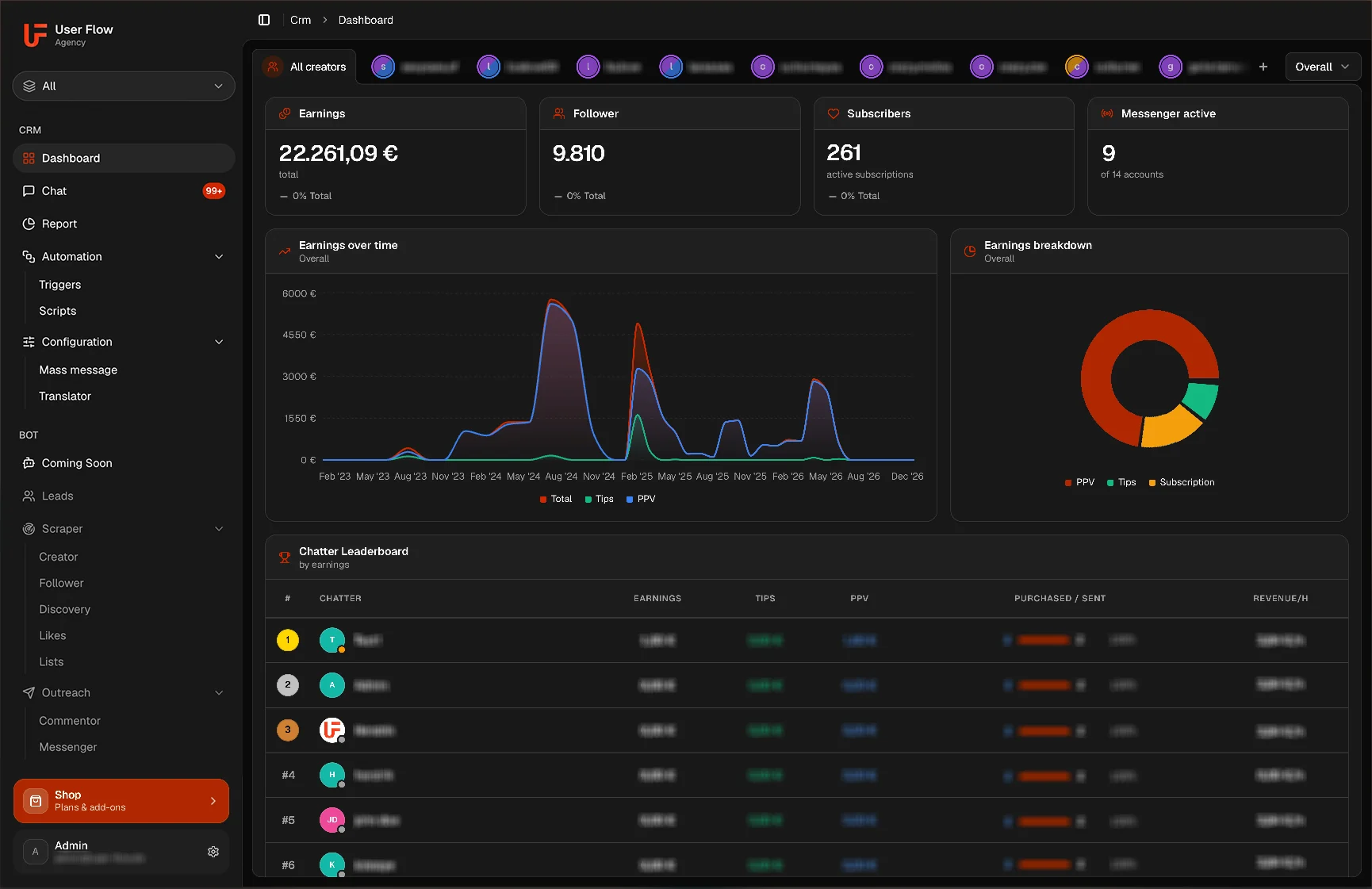
Show in the first conversation how you actually work.
CRM, bot and translator for Maloum and 4Based, every new creator runs in the same system, no special cases.
The three objections you will always hear on 4Based
You will hear these three sentences in almost every first conversation. They are not a sign of disinterest but the opposite: people who are not interested do not object, they simply stop replying. What matters is having a prepared, honest answer to all three.
"The platform already takes 30 %"
The most justified of the three, and the only one where arguing it away is guaranteed to backfire. The platform fee is higher than at the big international providers, and your share comes on top of it. What helps is an open calculation instead of a percentage comparison: what is left at the end, and what would be left if this person carried on doing everything alone, including the hours that go into it? Anyone who cannot show that calculation does not look like a tough negotiator, they look like someone who never did the maths themselves. The platform comparison is in 4Based vs. OnlyFans for Agencies.
"There is hardly anyone there"
In absolute numbers that is true, and you should not dispute it. The right counter-figure is not reach but competition: on a smaller market far fewer profiles fight over the same attention, and the audience is German-speaking and willing to pay. Anyone looking for a mass English-speaking audience, however, is better off elsewhere, say so. An honest "then this is the wrong place for you" buys you more credibility than a signed creator who quits disappointed after eight weeks. The full assessment is in 4Based Reviews: Is the Platform Legit?
"But my fans are somewhere else"
Also true, and the easiest of the three to resolve, because the answer is not a contradiction but a smaller proposal. Nobody has to move. The German-speaking part of the audience can be built up step by step while everything else keeps running. That turns an either-or in which the creator can lose something into an as-well in which they risk nothing.
The referral model: useful, but no substitute for acquisition
4Based has something most platforms do not: whoever invites a creator to the platform earns an ongoing share of their income. For an agency that has two sides, and you should know both before you rely on it.
The good side: satisfied creators now have their own, platform-backed incentive to bring others along. The channel with the highest close rate anyway gets rewarded without you having to set up a referral bonus of your own.
The flip side: that very incentive tempts you to put volume over fit. An invited creator who quits after six weeks is worth nothing to anyone, not to you, not to them, and not to the person who referred them. So treat the model as an amplifier of a working selection process, not as a replacement for one.
And one point that reliably causes conflict later if it is not settled early: who owns that referral income? Contracts originally written for other platforms say nothing about it. Settle it in writing before the first payment exists, not afterwards. The same point from the creator's perspective is described in Finding a 4Based Agency, worth reading once from the other side.
The first month decides whether you can plan the second
Acquisition without reporting is gambling with extra steps. After the first month with a new creator you should be able to answer three things without guessing: which of the three groups did they come from? How much support did they actually cost? And what was left at the end?
Only those three answers tell you which group works for your agency, and that differs from agency to agency. One with a strong chat team does best with group 1. One with a good grasp of numbers wins group 2. One with patience and spare capacity builds its most stable base through group 3. Without measuring it you will repeat the same acquisition in month two and wonder about the same result.
The ground rules that stay the same on every platform, age verification without exception, no copied bulk messages, no revenue promises, no contracts nobody can leave, are explained with reasoning in Finding Creators for Your Maloum Agency. They are no different on 4Based, only the scene they travel through is smaller.
Search on the platform itself first, address gaps rather than reach, keep an open calculation ready for the 30 % question, and never sell anyone a move. Then measure after the first month which of the three groups actually works for you.
Frequently asked questions
Where do I find creators for my 4Based agency?
In three groups: creators already active on 4Based who do everything alone, switchers and parallel operators from larger platforms, and German-speaking creators with no platform experience. The first group is the fastest because the platform question is already answered for them. The third creates the strongest loyalty but costs the most support.
Why is finding creators different on 4Based than on other platforms?
Because three things only come together here: the market is limited to the German-speaking region and therefore smaller, almost nobody starts from zero, and the platform is younger, so in a first conversation you answer questions about the platform before questions about yourself. Volume tactics do not work on a small market and stand out negatively.
How do I convince a creator despite the 30 % platform fee?
Not by arguing it away, but with an open calculation. Do not compare percentages, compare what is left at the end against what would be left if the person carried on alone, including the hours invested. Anyone who cannot show that calculation looks like someone who never did the maths themselves.
What does the 4Based referral model do for me as an agency?
It rewards the channel with the highest close rate, referrals from satisfied creators, without you having to set up a bonus of your own. But it tempts you to put volume over fit. Also settle in writing who owns the referral income before the first payment exists.
How many creators should I take on at the start?
As many as you can still evaluate individually after the first month. What matters is not the number but whether you can say per creator where they came from, how much support they cost and what was left. Without those three answers you repeat the same acquisition in month two and get the same result.