



Why the old idea of a "bot" is often completely wrong
Many blog articles about bots make it sound like a single system handles everything: greetings, reactivation, mass messages, campaigns, chat management, and seemingly the entire revenue. But in practice, that's often simply not the reality.
Both halves of this split have their own product page: the Maloum Bot for new users and the Maloum CRM for everything after.
If we're being honest, you have to draw a clear line: What does the bot really do? And what only makes sense once it runs through a CRM with additional automations?
In our setup, the bot isn't there to automatically handle the whole fan journey. It's there to message new users who were scraped beforehand. Everything else can then be automated in a far more structured and sensible way through a connected CRM.
The biggest mistake isn't too little automation. The biggest mistake is attributing capabilities to the bot that should really come from a good CRM system.
What the Maloum Bot really does for us
In our setup, the Maloum Bot has one clear main task: It messages new users who were scraped beforehand. That's exactly what it's for. It's meant to enable first contact and set the starting point for further processes.
That also means: the bot isn't there to run complete fan relationships automatically. It doesn't replace a chatter, real timing, or proper care. It's the first step in a system, not the whole system itself.
For agencies in particular, this matters, because it lets you draw a clean distinction: the bot gets new contacts moving, while the CRM then takes over structure, follow-ups, and further automations.
BotMessaging new, scraped users
The core of the bot: automatically message new users who were scraped beforehand, making first contact scalable.
BotFirst contact instead of full automation
The bot starts conversations, but it isn't meant to automatically take over complete chat histories or deeper sales logic.
BotMore reach for agencies
Instead of messaging individual contacts manually, the bot can map the outreach process much faster and in a more structured way.
BotA clean starting point for further processes
As soon as a user responds, the CRM can take over and manage further automations, assignments, or follow-ups.
Which additional automations are possible in the CRM
The real leverage comes when the bot is connected to the CRM. Because that's where automations can run that no longer concern just the first contact, but cleanly structure the rest of the process in the system.
This is exactly where the things belong that many other articles wrongly attribute, across the board, to the bot.
CRMWelcome message with follow-ups
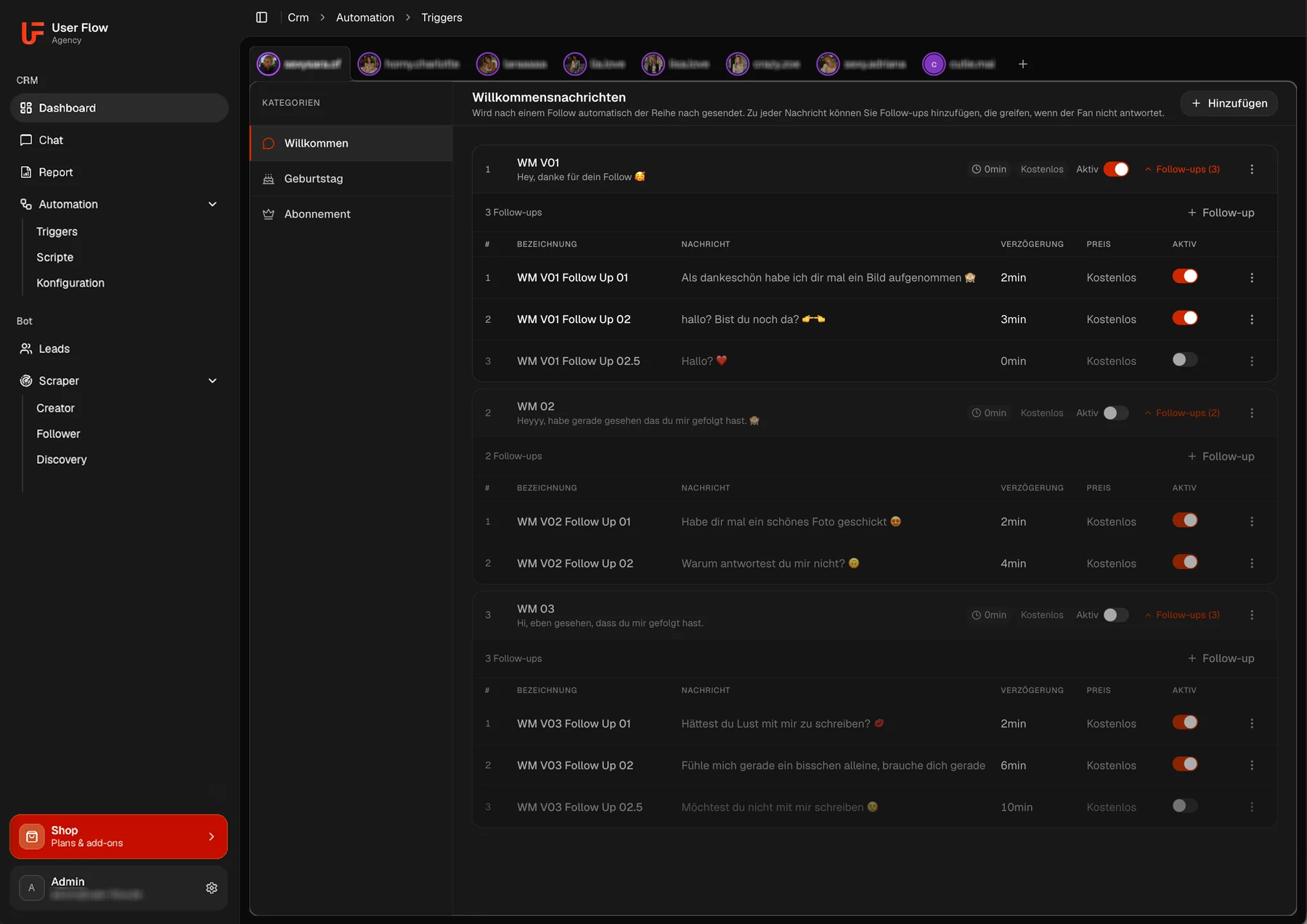
As soon as a contact is in the system, a welcome message can be sent automatically. If the user doesn't respond, suitable follow-ups go out at defined intervals.
CRMSubscription message with follow-ups
When a new subscription comes in, a suitable message can go out automatically. If the user doesn't reply, further follow-ups can be triggered fully automatically.
CRMBirthday message
Birthdays can be caught automatically, so a message goes out at the right time, fittingly and without manual effort.
CRMAutomatically withdraw mass messages
Mass messages can not only be sent automatically, but also automatically withdrawn again after a certain time. This gives you more control over the messaging process.
CRMAuto Follow
If a user follows you, you can follow back automatically. On Maloum in particular, this can make sense, because it isn't visible from the outside how many users a creator follows.
Why the Bot and CRM are much stronger together
It's only in combination that this becomes a truly clean agency system. The bot takes care of messaging new contacts. The CRM then handles the rest of the process: greeting, follow-ups, subscription messages, birthdays, mass messages, and additional process logic.
This doesn't create a chaotic dumping ground of individual tools, but a structure: outreach through the bot, process and automations through the CRM.
That's exactly what makes it interesting for agencies, because it's not just about individual messages, but about a repeatable process you can cleanly manage across multiple creators, chatters, and accounts.
01.The bot brings in new contacts
Scraped users are messaged automatically. This makes first contact scalable and far less manual.
02.The CRM takes over structure and follow-up logic
Welcome messages, subscription messages, follow-ups, birthdays, and Auto Follow don't run in isolation, but cleanly within the system.
03.Agencies get a repeatable process
Instead of having to improvise from scratch every time, you get a clear process that can be managed sensibly across multiple accounts and creators.
Outreach through the bot. Process through the CRM.
That's exactly how individual messages turn into a clean agency system with real structure.
What neither the Bot nor the CRM should replace
As helpful as automation can be, there's a point where tools end and real care begins. Neither the bot nor the CRM should be portrayed as if they completely replace personal conversations, real timing, or good sales in the chat.
A tool can nudge, follow up, trigger, and structure. But it doesn't automatically take over all of the quality in the chat for you. That's exactly why being honest about the system is so important.
The bot is not a complete chat replacement. And the CRM is not a substitute for real sales quality. Both are there to structure workflows and free up time, not to make care feel completely artificial.
UserFlow CRM for Maloum agencies
UserFlow was built for exactly this: not just to be a tool that somehow sends messages, but a system that helps agencies organize their workflows cleanly. The bot handles first contact with new, scraped users. The CRM then takes over the automations and the structure behind them.
This doesn't just let you map more workflows, but also lets you manage multiple creators, chatters, and touchpoints far more cleanly than with isolated standalone solutions.
BotOutreach to scraped users
Message new users and automatically set the starting point for further processes.
CRMWelcome message with follow-ups
New contacts can be greeted systematically and, if there's no reply, automatically contacted again.
CRMBirthday and subscription automations
Important events can be detected automatically and addressed with suitable messages, including follow-ups.
CRMMass messages with withdrawal
Mass messages can be sent automatically and later withdrawn again after a defined time.
CRMAuto Follow
When a user follows you, you can follow back automatically, fitting the logic of Maloum.
SystemOne process instead of separate tools
The bot and CRM mesh together and turn outreach, follow-up, and care into one clear workflow for agencies.
The CRM for Maloum agencies.
UserFlow combines outreach through the bot with useful automations in the CRM. Join the waitlist and secure early access.
Ready to put this to work in your agency?
CRM, Bot and Translator in one tool – built for Maloum and 4Based agencies. Start now for free, no risk.
Frequently asked questions about the Maloum Bot and CRM
What does the Maloum Bot really do?
The Maloum Bot primarily messages new users who were scraped beforehand. So it's mainly intended for first contact and not for automatically taking over complete chats.
What runs through the bot and what through the CRM?
The bot handles outreach to new, scraped users. The CRM then adds automations such as welcome messages with follow-ups, subscription messages with follow-ups, birthday messages, Auto Follow, and the automatic withdrawal of mass messages.
Can the bot replace the entire chat?
No. The bot is not intended to fully replace deeper conversations, sales logic, or personal care.
Why is the CRM connection so important?
Because the bot alone only covers part of the process. It's only through the CRM that further automations, structure, and a clean agency workflow emerge.
Which CRM automations are especially strong?
Especially strong are welcome messages with follow-ups, subscription messages with follow-ups, birthday messages, Auto Follow, and mass messages that are automatically withdrawn after a certain time.
Who is this system interesting for?
Above all for agencies that don't just want to do outreach, follow-up, and care somehow, but want to structure it cleanly as a repeatable process.