




On OnlyFans the language question runs the other way
On Maloum and 4Based the language barrier is a staffing problem: the audience is German-speaking, and a translator lets you hire chatters from any country. That is how it is described in Maloum translator: chatters without a drop in quality.
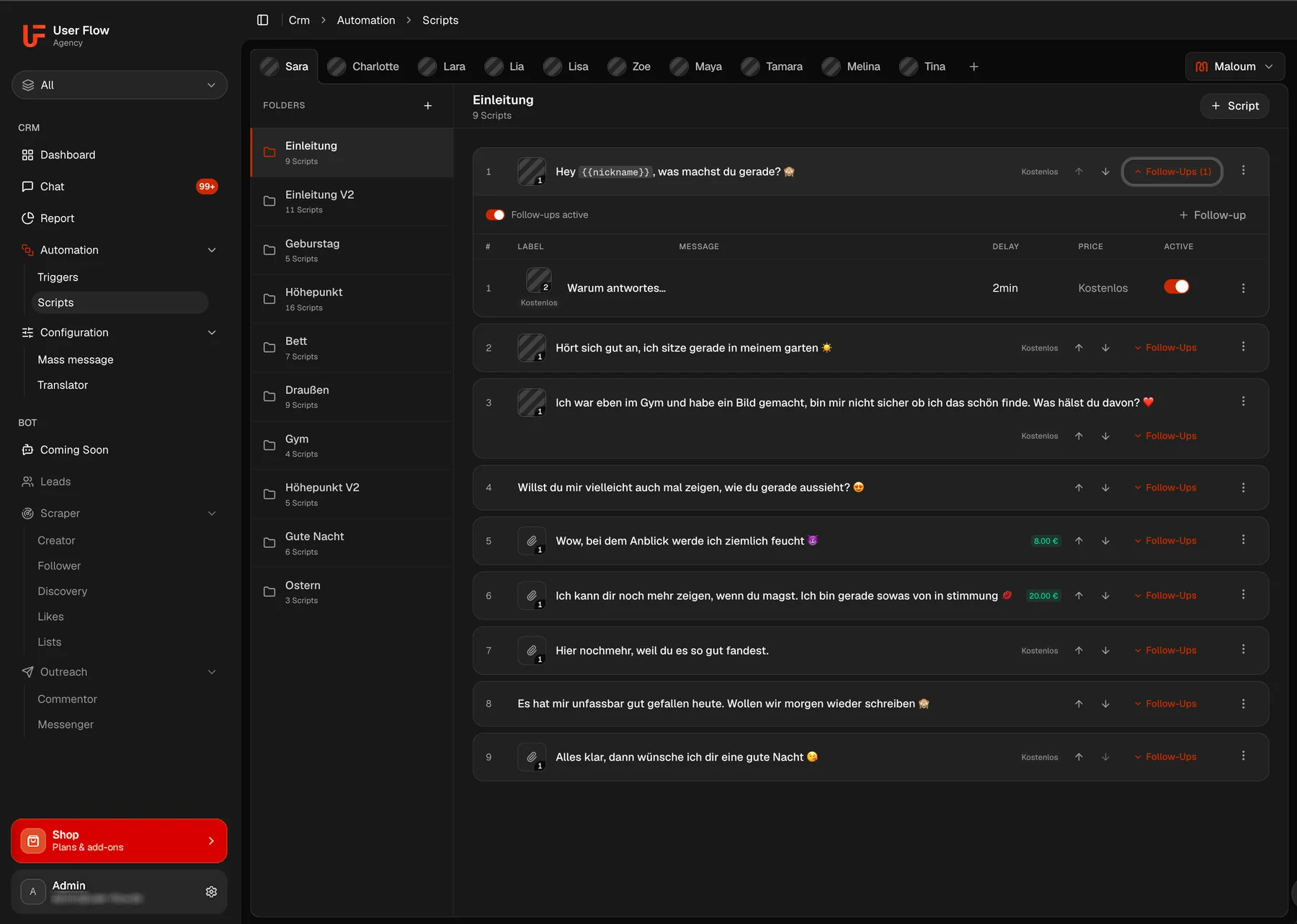
The OnlyFans Translator sits right in the chat window; the details are on the product page.
On OnlyFans it reverses. Your team sits in the German-speaking world and the audience does not. It is not the chatter who has to be translated in order to understand the fan, the fan has to be understood so the chatter can connect at all. And because the audience does not come from one country, it is not one foreign language but a main language and several secondary ones.
In practice: English is the baseline, not the goal. Covering only English serves the largest part of the market and leaves behind a remainder that often pays above average, precisely because nobody else addresses it in its own language.
Translation fails at register, not at vocabulary
A translator that renders sentences correctly is not the problem these days. The problem sits one level above that, and it weighs more heavily in this work than in almost any other.
A chat on this kind of platform is not an exchange of information. It lives on suggestion, timing, irony and a particular tone, exactly what a literal rendering loses first. A sentence can be grammatically flawless and still land wrong, because it sounds too formal, too direct, or simply too correct.
You never see the result as an error. The fan does not say "that sounded odd". He replies more briefly, then less often, then not at all. That is why register is not a nicety but the actual subject.
The three places it typically tips over
Address and closeness. German has a level of distance that English does not, and many Romance languages have more of them. Coming from German, you easily land too formal in English, and formal is the opposite of what is wanted here.
Humour and irony. This is the part that travels worst, because it is cultural rather than linguistic. A joke that works in German is often just an odd statement once translated.
Prices and commitments. Here precision matters more than tone. Misunderstandings about amounts, currencies or what exactly was promised lead to chargebacks, and those cost more than the sale brought in.
A message that is linguistically correct but wrong in tone produces no complaint. It produces a shorter reply, then a rarer one, then none. In the reporting that looks like a fan who lost interest, not like a translation problem.
The night shift is a language problem too
That the strongest buying hours for a US audience fall in your night is a planning matter, covered in OnlyFans chatter management. But it has a linguistic side that easily gets overlooked.
The shift that is hardest to fill is also the one where the most English gets written. So two requirements coincide that are each difficult on their own, available at night and confident in tone in a foreign language. Demanding both at once means searching longer or paying more.
A translator shifts that calculation, because it defuses one of the two requirements: you can then hire for availability and chat quality rather than for language level. It does not replace it, somebody still has to be able to judge whether a reply fits. But the pool of people who can be considered for that shift gets considerably larger.
What you have to define for translation to hold
A translator does not become good by being switched on, but by being given a foundation. Three things you have to decide yourself, no tool does them for you.
What is never translated. The creator's name, product names, fixed terms for particular offers. If the same thing has three names across three conversations it looks unprofessional, and with the same fan across several shifts it looks like a different person.
How the persona sounds. If a creator is cheeky in German, they have to be cheeky in every language. That is not a translation decision but a specification that has to exist beforehand in order to be carried across at all. Without it, the same creator sounds different depending on the chatter.
Where the line is. What is not said, what is not promised, which questions get handed off. Those limits are language-independent, but they get crossed more often in a foreign language, simply because an unsure chatter gives in more readily than in their native tongue.
When a second language is actually worth it
The obvious assumption is that every additional language means additional revenue. In practice that is a question of order, not of principle.
As long as English is not cleanly covered around the clock, a second language brings nothing, you are spreading the same scarce attention across more fronts. English first, completely, then expand.
Once that is achieved, what decides is not the size of a language area but how well it is already served. A smaller market where hardly anyone writes in the local language can deliver more than a large one where everybody competes. What you measure is the same number as in outreach: paying fans per language, not messages per language.
And a caveat that rarely gets mentioned: more languages mean more handovers between people who cannot read each other. Without a recorded fan history, a second language compounds the problem described in OnlyFans CRM rather than solving it.
What that means for your setup
Taken together, the language question on OnlyFans is not an add-on but part of the basic setup: English as the standard with a secured tone, fixed terms and a persona that stays the same in every language, and a history that holds up even when the next chatter does not speak the previous language.
Which of that is available today for which platform, we say openly.
Hire chatters for quality, not for language level.
CRM and translator for OnlyFans: translation right inside the chat, fixed text blocks and the fan history beside the conversation. The bot runs on Maloum and 4Based. Everything is €0 during the beta.
Frequently asked questions
Does a German agency need a translator on OnlyFans?
The language question here runs the opposite way to the German-speaking platforms: the team sits in the German-speaking world, the audience does not. English is the baseline, not the goal. A translator is useful above all because it detaches the hiring decision from language, you can select for availability and chat quality rather than for language level.
Why is a correct translation not enough?
Because a chat on this kind of platform lives on suggestion, timing and tone, exactly what a literal rendering loses first. A sentence can be grammatically flawless and still land too formal or too direct. The fan never complains about it: he replies more briefly, then less often, then not at all.
Where do translations typically go wrong?
In three places. At address and closeness, because German has a level of distance English lacks, you easily end up too formal. At humour and irony, because those are cultural rather than linguistic. And at prices and commitments, where precision matters more than tone: misunderstandings about amounts lead to chargebacks.
What has to be defined before a translator helps?
Three things no tool decides. What is never translated, creator name, product names, fixed terms. How the persona sounds, so the same creator does not come across differently depending on the chatter. And where the line is: what is not said and not promised gets crossed more often in a foreign language, because unsure chatters give in more readily.
When is a second language worth adding alongside English?
Only once English is cleanly covered around the clock. Before that you are spreading the same scarce attention across more fronts. After that, what decides is not the size of a language area but how well it is already served, a smaller market where hardly anyone writes in the local language can deliver more than a large one with a lot of competition.
What do you measure in multilingual chat?
Paying fans per language, not messages per language. And you should factor in that more languages mean more handovers between people who cannot read each other, without a recorded fan history, a second language sharpens the handover problem instead of bringing revenue.