





On OnlyFans every fan has a price before he pays
Why standard tools generally fail in this business is covered in Maloum CRM: why standard tools fail. On OnlyFans there is an additional argument that does not exist in the same form on the German-speaking platforms, and it is purely economic.
Looking for the product rather than the context? What UserFlow actually does on OnlyFans is on the OnlyFans CRM page.
Because the platform has no discovery function, every single fan arrived through an external channel: Reddit, X, TikTok or a collaboration. So he cost working hours before he brought in a single cent. Which channels those are and what they cost is covered in OnlyFans outreach.
That changes what a lost fan means. On a platform with its own traffic, a fan who stops replying is lost revenue. On OnlyFans he is lost revenue plus the acquisition that brought him and is now written off. A CRM here is not an organising tool but the protection of an investment you have already paid for.
The three things that disappear first without a system
They do not all vanish at the same speed. It happens in this order, and nobody notices the first two.
First: where the fan came from
This disappears immediately, because nobody writes it down. The fan is here, so people write to him, which channel brought him interests nobody in the moment of the conversation. Three months later that is exactly the information missing when you decide which channel to keep running. Then it gets estimated, and estimates always favour the channel that feels best.
Then: what he was promised
A custom video by Friday, a discount next time, an answer to a question, it is in the chat log and therefore theoretically available. In practice nobody finds it again once two hundred messages sit on top of it and the person who promised it is three shifts away. A promise not kept costs more than one never made.
Last: that he existed at all
Fans rarely quit with an announcement. They go quiet, and quiet does not stand out, because it generates no notification. Without a view showing who has not written in four weeks, people simply drop out of sight, along with the acquisition they cost. Which signals come before that is covered in Why fans stop paying.
None of the three losses produces an error. Nothing crashes, nobody complains, revenue does not collapse, it just grows more slowly than it should. That is why buying a system is almost always decided too late: there is no moment where it hurts.
Channel origin is the most expensive of the three
Losing the channel origin sounds like a minor reporting detail. It is the most expensive one, because it compounds every month.
Without that attribution you make the most important decision in your marketing, which channel to keep and which to drop, on gut feeling. And since all four channels cost different amounts of work, the odds are high that you keep the most laborious one because it produces the biggest numbers, and cut the quiet one that was bringing the paying fans.
What it takes is very little: a field on the fan recording where he came from, and the ability to group by it at the end of the month. Two data points per fan become the only reliable statement you have about your marketing, how many paying fans each channel brought, not how many clicks.
What a CRM cannot do on OnlyFans
A lot gets promised in this area, so here is the honest part first, three things no system solves, and expecting them leads to disappointment.
It does not replace traffic. A CRM manages fans, it does not acquire them. Anyone without working channels has the same empty inboxes after adopting one, just better sorted.
It does not make bad chatters good. It shows you who has a low buy rate, which is valuable, because otherwise you would not know. What happens with that information stays a staffing decision, not a software question.
It does not lift platform limits. What is technically possible on OnlyFans is set by the platform, and no tool changes that. A system promising otherwise is promising a risk.
What remains is still the core of the business: that information about a fan reaches whoever is writing to him right now. How that is organised across shifts is covered in OnlyFans chatter management.
How you know the moment has come
The usual answer is "from three creators" or "from five chatters". Both are useless, because there are agencies with two creators who urgently need one and agencies with five who manage without. The tipping point is not size but whether several people need access to the same information at the same time.
Four signals are unambiguous, and you only need one of them:
- Somebody asks a fan the same thing twice. That is not carelessness, it is a missing history.
- You cannot say which channel brought paying fans last month. Not roughly, specifically.
- Shift changes involve asking rather than reading. If the handover is a conversation, it only happens when both people are online at once.
- There is one file per creator. The moment you switch between files to answer a question, you are working against your own tool.
Anyone seeing none of these signals does not need anything yet. Anyone who recognises two is already losing money, just not visibly.
What that means in practice
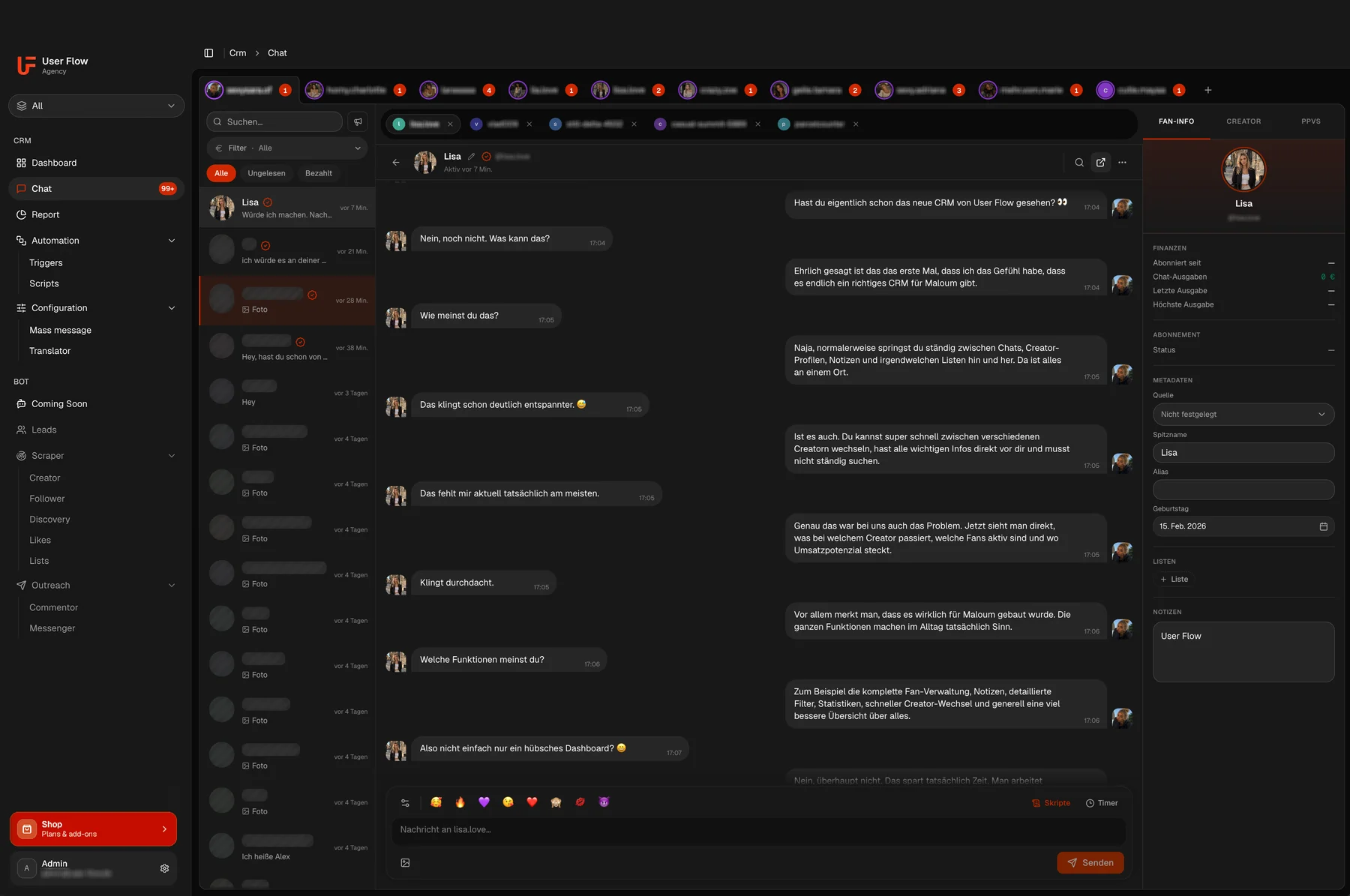
A usable system for this work consists of few parts, and none of them is spectacular: the history on the fan rather than in the chat log, the origin as a field rather than in someone's memory, one view across all creators rather than a file per account, and metrics per chatter rather than a total that mainly reveals who had the better shifts.
Which of that is available today for which platform, we say openly, with a tool meant to be used daily, that matters more than any promise.
The system that keeps the fans your marketing paid for.
CRM and translator for OnlyFans: fan history beside the conversation, origin per fan, buy rate per chatter, every creator in one view. The bot runs on Maloum and 4Based. Everything is €0 during the beta, so starting now means the processes are already in place.
Frequently asked questions
Why does an OnlyFans agency need a CRM?
Because on OnlyFans every fan arrived through an external channel and therefore cost working hours before bringing in a single cent. A fan who goes quiet is not just lost revenue but an acquisition you already paid for that is now written off. A CRM here is less an organising tool than the protection of an investment.
When is a CRM worth it instead of a spreadsheet?
Not from a particular number of creators or chatters, the tipping point is whether several people need access to the same information at once. Four signals are unambiguous: somebody asks a fan the same thing twice, you cannot say specifically which channel brought paying fans, shift changes involve asking rather than reading, and there is one file per creator.
What is lost first without a system?
In this order: where the fan came from, what he was promised, and finally that he existed at all. Nobody notices the first two, because they produce no error. The third goes unnoticed because fans rarely quit with an announcement, they go quiet, and quiet generates no notification.
Why does channel origin matter so much?
Because without it the most important marketing decision, which channel to keep, rests on gut feeling. Since the channels cost different amounts of work, people usually keep the most laborious one because it produces the biggest numbers and cut the quiet one that was bringing the paying fans. All it takes is two data points per fan.
What can a CRM not do?
Three things. It does not replace traffic, without working channels you have the same empty inboxes afterwards, just better sorted. It does not make bad chatters good, it only makes them visible. And it does not lift platform limits: what is technically possible is set by the platform. A system promising otherwise is promising a risk.
Does UserFlow support OnlyFans?
Today UserFlow covers Maloum, 4Based and OnlyFans: CRM and translator on all three, the bot on Maloum and 4Based. Since everything is currently free during the beta, an agency can set up its processes now at no risk.