





What a Maloum system really is
A Maloum system is not a tool and not a software licence. It is the fixed structure your agency uses to run its accounts: who takes which chat, where fan knowledge lives, where new users come from and how you know at the end of the day whether it worked.
This article describes the structure; the Maloum CRM page describes the tool behind it.
The difference is easy to test. Imagine your best chatter quits today. If fan preferences, running conversations and open PPV deals disappear with them, you had a person, not a system. If a new chatter steps into the same chat the next day and sees what the fan likes, what they last bought and where the conversation stood, you have a system.
That is exactly what revenue hangs on. On Maloum around 80% of earnings happen in chat, not in the feed. Anything that interrupts the chat, makes it unclear or leaves it dependent on memory costs you money directly.
A Maloum system makes your revenue depend on a repeatable process instead of individual people. It is transferable, measurable and scales with every additional account.
The 5 building blocks of a Maloum system
Whether you run one account or fifteen, a working system always consists of the same five parts. If one is missing, you will notice the moment you grow.
1. Fan data in one place
Preferences, purchase history, names, boundaries, triggers: everything that defines a fan belongs in one place where every chatter finds it in seconds. As long as that knowledge sits in heads, notes and Telegram groups, every shift starts from zero. Why ordinary spreadsheets and standard CRMs cannot deliver this is covered in Maloum CRM: Why Standard Tools Fail.
2. Clear chat and chatter ownership
Every chat needs an owner, every shift a clean handover. Without that ownership two things happen: fans get messaged twice or not at all. Both cost trust, and on Maloum trust is the currency PPV purchases are made of. How to build a team that holds up is in Building a Chatter Team on Maloum: Recruiting, Training, Control.
3. An automated supply of new users
A system that only manages existing fans stagnates. You need a predictable inflow of new users without a human clicking through profiles all day. That is what the bot does: find, message, bring into the chat. What it can do and where its limits are is in Maloum Bot: Automation & Strategy.
4. The language barrier out of the way
The best chatters are not necessarily based in Germany. German fans notice immediately when a message reads like a translation, and they drop off. A translator that runs directly inside the chat opens up the international labour market without hurting quality. Details in Maloum Translator: Chatters Without Quality Loss.
5. Numbers you see every day
Revenue per chatter, purchase rate per shift, response times, development per account: without these numbers you manage on gut feeling. With them you can see within a week which chatter needs training and which one deserves more responsibility.
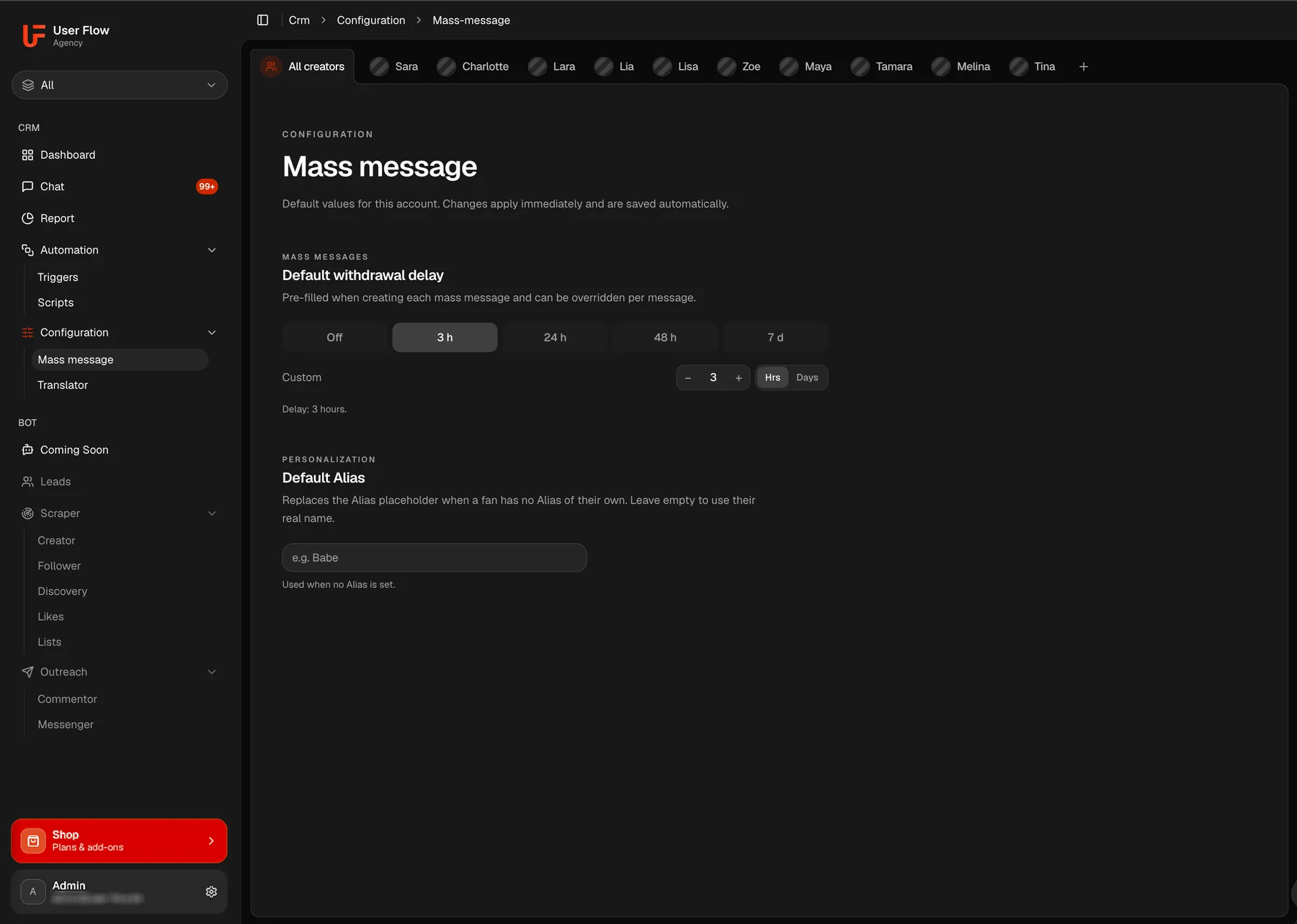
All five building blocks in one system.
CRM, bot and translator work together instead of sitting in three separate tools. Built for Maloum agencies, straight in the browser.
Your Maloum system in 7 days
You do not need months of planning. If you stick to this order, your system runs after a week, and the order matters because the blocks build on each other.
Day 1–2: Pull fan data together
Everything that is scattered today moves into one place. Do not start with all your fans, start with the top 20% by revenue. For each: name, purchase history, preferences, where the conversation stands. This is the least pleasant part, and it is due exactly once.
Day 3–4: Lock down chatters and shifts
Define who runs which accounts and which chats, and design a handover that takes two minutes. Important: the handover happens inside the system, not in a voice message. From here on every shift is traceable.
Day 5: Switch the bot on
Only now do you open the tap. The reason is simple: new users who land on a disorganised team are burnt traffic. With the structure in place, every new chat is picked up properly.
Day 6–7: Sharpen the numbers
Define the three metrics you actually track. For most agencies that is revenue per chatter, PPV purchase rate and average response time. Everything else is a distraction at the start. After the first full week you have a baseline to optimise against.
The most common mistake is starting with the bot because it produces visible results fastest. Pushing traffic into a system without structure only scales the chaos. Data first, then team, then inflow.
The 4 most common mistakes
We see these four again and again at agencies, and all four are avoidable.
Three tools instead of one system
A spreadsheet for fans, a chat tool for the team, a translator in a second tab. Every switch costs seconds and context, and that context is the difference between a PPV that sells and one that gets ignored.
A system built only for yourself
If you are the only one who knows how your structure works, it is not transferable. The test: could a new chatter take a shift after 30 minutes of onboarding? If not, it is not a system yet.
Trying to measure everything
Twenty metrics mean none of them has consequences. Three numbers discussed weekly will change your team's behaviour. You do not need more than that at the start.
Waiting for the right moment
"We'll build the system once we have five accounts" is the order agencies fail on. The system is the prerequisite for the fifth account, not its reward. What that looks like while growing is in Scaling a Maloum Agency: The System From Account 1.
When a Maloum system pays off
The honest answer: earlier than most people think. As long as one person runs one account, their head still holds the system together. It breaks at the second chatter or second account, because from then on every shift has to be handed over.
Run the numbers on a single figure: if a better chat structure lifts your PPV purchase rate by three percentage points, that is more than the entire tool stack costs at most agencies. And the structure works again on every additional account, at no extra effort.
A Maloum system consists of fan data, chatter ownership, automated inflow, translation and numbers. Build it in that order before you onboard the next account, not afterwards.
The same setup applies if you also work on 4Based. The platforms differ in reach and fees, the five building blocks stay identical, and a good system runs both from the same interface.
Ready to put this into practice in your agency?
CRM, bot and translator in one tool – built for Maloum and 4Based agencies. Start free, no risk.
Frequently asked questions
What is a Maloum system?
A Maloum system is the fixed structure an agency uses to run its Maloum accounts: fan data in one place, clear chat and chatter ownership, an automated supply of new users, a solution for the language barrier and numbers you see every day. Without that system your revenue depends on individual people instead of a repeatable process.
When do I need a Maloum system?
By the second account or the second chatter at the latest. As long as one person runs one account, their head still holds the system together. The moment shifts get handed over, every handover loses context, and context is revenue.
Are Excel and Telegram enough as a Maloum system?
For one account and one chatter it works for a while. It breaks at the handover: spreadsheets are not kept live, Telegram threads are not searchable and nobody can see which chatter produced which revenue. That is exactly the point where most agencies move to a CRM.
How long does it take to set up a Maloum system?
The technical part takes one to two days because UserFlow runs in the browser with nothing to install. Realistically, plan about a week until fan data is maintained, chatters are trained and your first numbers are reliable.
Does the same system work on 4Based?
Yes. The five building blocks are platform independent, and UserFlow supports Maloum and 4Based with the full feature set. Agencies working on both platforms run them from the same system.