





The problem: hiring chatters and hoping
The typical approach in Maloum agencies looks like this: someone gets in touch in a Telegram group. A quick conversation. Account access handed over. Done. As of today, they're supposed to make money.
Chatter assignment, shifts and revenue per chatter all come together in the Maloum CRM.
What happens after that, usually nobody knows exactly. The chatter chats, somehow. The agency sees the earnings at the end of the month. And when the numbers are bad, nobody knows why.
That's not building an agency. That's gambling. And it costs revenue every day, not as a one-off loss, but as structural damage that repeats every month.
01.No selection process
Whoever is interested gets access. No test, no trial task, no clear requirements. Bad chatters get in, and stay, because nobody measures their performance.
02.No structured onboarding
The new chatter might get a few tips over Telegram, and then they're on their own. What they're supposed to do, how they should write, what goals they have: unclear.
03.No performance data
PPV purchase rate, revenue per hour, response speed, nobody sees these numbers. Who is good and who isn't stays a gut feeling. That makes feedback impossible.
04.No clear expectations
When should the chatter be online? How fast should they respond? Which purchase rate is the goal? Without defined standards there is no basis for criticism, or praise.
What a bad chatter really costs
A bad chatter costs not only revenue, they also cost you fans. Anyone who responds slowly, writes generically or sends out PPVs blindly burns the trust of your best payers. And a lost top fan is hard to win back.
A concrete example: an account generates 3,000€ a month, at a PPV purchase rate of 15%. A trained chatter with structure and feedback brings the same base up to 28%. That's over 2,000€ more per month from this account alone, without new content, without new fans.
An empty chat slot costs you money. A bad chatter costs you more, because they actively burn fans you'll never get back.
Most agencies underestimate the damage a bad chatter does, because they have no data. With tracking you see the loss immediately.
Finally see who in your team is actually making money.
The first CRM for Maloum agencies, with a chatter leaderboard, PPV tracking and real-time performance reports.
Recruiting: how to find good chatters
Good chatters don't fall from the sky. You have to search actively, and above all select actively. The channel is secondary. The process is what matters.
Where to find chatters
The realistic sources: relevant Telegram groups for Maloum agencies, your existing network of other agency operators, and active posting in communities. Important: those who search actively find more than those who wait.
What to find out in the first conversation
- Experience: Have they already chatted on Maloum or similar platforms? If so, what purchase rates did they have?
- Availability: When are they online? How many hours a day can they chat? Reliability matters more than experience.
- Language: Can they write convincingly in German, or do they need the integrated translator? Both scenarios work, but you need to know.
- Attitude: Do they want to generate revenue, or just be online somehow? Motivation is hard to train.
The trial task, your most important filtering tool
Before you grant access, you give a trial task: a realistic chat scenario that you evaluate yourself. How do they respond to a hesitant fan? How do they sell a PPV? How do they handle a rejection?
Anyone who doesn't want to do a trial task doesn't really want to work either. With this rule you save yourself a lot of time and bad experiences.
Never hire a chatter who hasn't done a trial task, no matter how convincing they seem in the conversation. Talk is cheap. The chat screen decides.
Training: how to turn them into converters
Recruiting is the first step. Training is the decisive one. Even a chatter with potential converts poorly if they don't know what to do, and above all how.
What good chatter training includes
A solid onboarding document covers at least these five areas:
PersonaWho is the creator, and how do they sound?
Tone, language, personality. The chatter writes as the creator, they have to sound like that person. Not generic, not copy-paste.
ScriptsExample replies for every situation
PPV sale, rejection, renewal after a subscription ends, reactivating an inactive fan, for every case an example that converts.
TimingWhen and how fast to respond?
Define a maximum response time, set the main hours, clarify behavior during offline periods. Clearly defined, no gray areas.
GoalsWhich KPIs do you expect?
PPV purchase rate target, minimum chatting time, revenue target, clearly communicated from the start. No goals, no feedback.
No-GosWhat must never happen
Quoting prices that aren't right, making promises the creator can't keep, insulting fans, clear red lines, put down in writing.
Feedback LoopHow you give feedback
Weekly check-in, performance review based on real numbers, concrete suggestions for improvement, not gut feeling, but data.
The first two weeks are decisive
The first two weeks decide whether a chatter becomes good or not. Look at their numbers daily. Give concrete feedback, not "you could be better", but "your PPV purchase rate is at 12%, the goal is 25%. Here's what you change this week."
Anyone who shows no potential after two weeks usually doesn't show it afterwards either. Part ways early, it saves you months and fans.
The first Maloum CRM is coming, with full chatter tracking.
See every chatter's performance in real time. Give feedback based on real numbers instead of gut feeling.
Control: measuring and steering performance
The weakest link in most agencies' systems is control. Recruiting and training somehow happen, but after that: hope. Anyone who really wants to scale needs ongoing performance tracking. Not once a month. Not gut feeling. Real numbers, regularly.
The five KPIs you need for every chatter
01.PPV purchase rate
How many of the PPVs sent get bought? Below 20% is a clear signal. Above 30% is good. This number says more about a chatter than anything else.
02.Revenue per hour
How much money does the chatter make in the time they are online? This KPI shows you whether they actively use the time or are just "there".
03.Chatting time
How many hours do they actually chat? Some chatters are "online" but not active. Chatting time vs. agreed time shows you that immediately.
04.Total revenue
The absolute value, how much did they generate in this period? Combined with the other KPIs you can tell whether the potential is being fully used.
05.Response speed
How long do they take on average to reply? Fans who wait too long drop off, often without sending a single message. A fast response time is an underrated revenue lever.
How often you should review
For new chatters: daily during the first two weeks. After that: weekly. For experienced chatters with good numbers: every two weeks is enough. What matters isn't the frequency, but that you do it at all. Most agencies never review.
What to do when a chatter isn't performing
First: look at the data. Is it the PPV purchase rate, the chatting time or the response speed? Then give targeted feedback, concrete, with numbers, with a clear expectation of what changes. Then set a deadline: two weeks.
If nothing changes in those two weeks: part ways. Not because you have no heart, but because a bad chatter costs you fans and revenue every day that you'll never get back.
Control doesn't mean distrust, it means leading your team in a way that lets it grow. Without numbers you can't grow. With numbers you can improve in a targeted way.
UserFlow CRM: the tool behind your chatter team
All of this, recruiting process, training documents, performance tracking, can be built manually. But without the right tool you'll eventually hit a wall. At the latest when you onboard your third or fifth account.
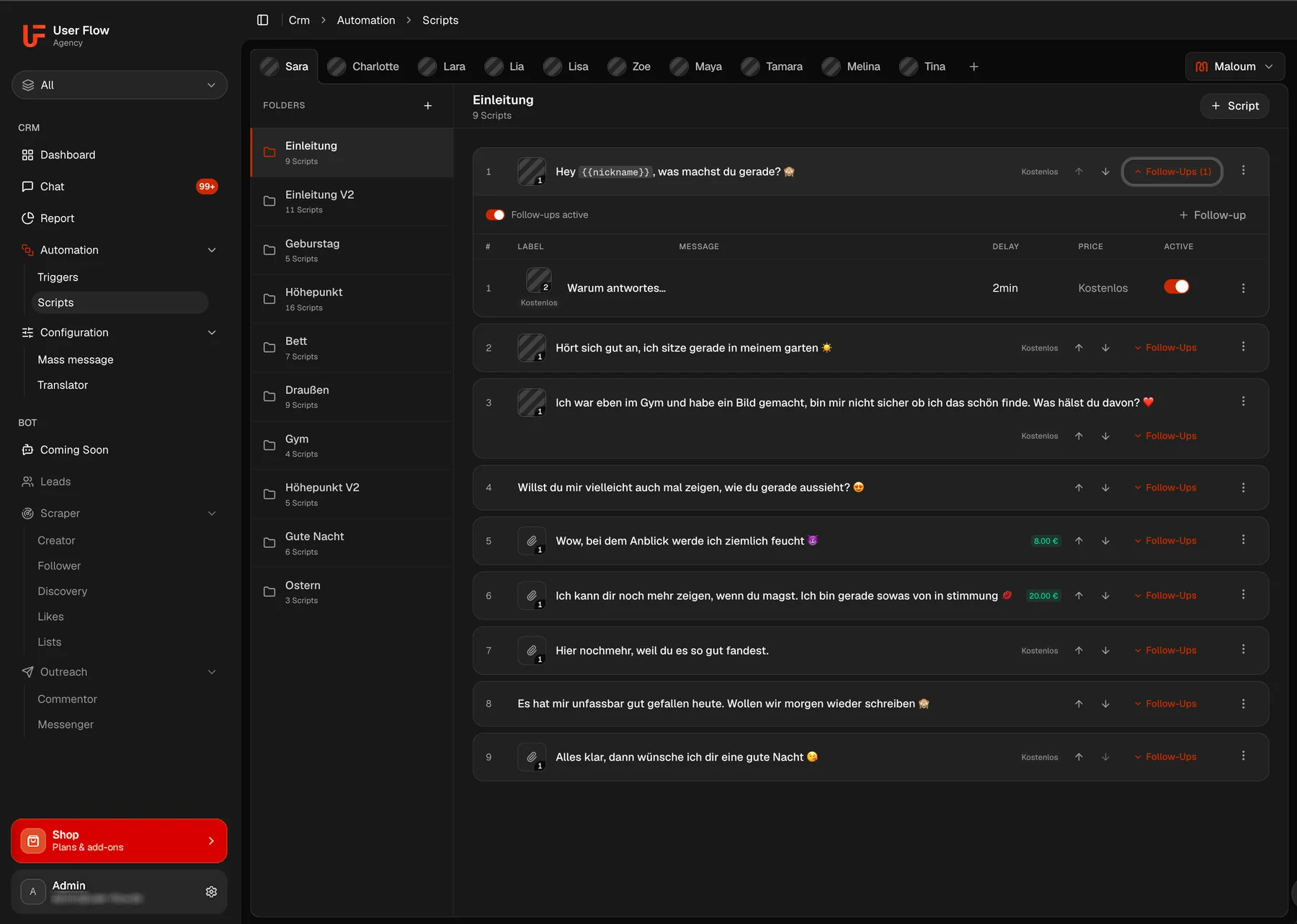
UserFlow CRM was built from the ground up for exactly this use case. Everything you need to run a chatter team professionally, in one system.
ReportChatter performance with real numbers
Earnings, PPV statistics, purchase rate, chatting time, revenue per hour, for each chatter individually or in comparison. Time period freely selectable.
DashboardChatter leaderboard by revenue
See at a glance who in your team really delivers, per creator or across the board. No guessing, just facts.
PPV TrackingPurchase rates in real time, per chatter
Which PPVs did this chatter send? How many were bought? What was the purchase rate? Per chatter, per creator, in comparison.
TranslatorInternational chatters without quality loss
Chatters from other countries chat in English, the translator automatically translates before the message reaches the fan. Can be enabled per chatter.
ChatsEach chatter sees only their accounts
Maloum chats mirror directly into the CRM. You can assign each chatter to specific accounts, with full control over access.
Fan InfoEverything about every fan, right in the chat
Total spend, subscription status, notes, fan lists, the chatter sees everything they need to personalize, without leaving the chat.
Lead your chatter team with real data.
UserFlow CRM is in its final development phase. Join the waitlist now, the first to sign up get early access and special conditions.
Ready to put this to work in your agency?
CRM, Bot and Translator in one tool – built for Maloum and 4Based agencies. Start now for free, no risk.
Frequently asked questions about the chatter team on Maloum
How do I find good chatters for Maloum?
You find good chatters in relevant Telegram groups, through referrals from your network and via targeted posting in agency communities. More important than the channel is the selection process: a trial task before onboarding, no direct hiring without a test.
What does a chatter earn on Maloum?
Most chatters work on a commission basis, typically 10–20% of the revenue generated. Top chatters in larger agencies can receive a fixed base salary plus commission. Important: communicate this clearly and in writing from the start.
How do I measure my chatters' performance?
The most important KPIs are: PPV purchase rate, revenue per hour, chatting time and response speed. With UserFlow CRM you see all of these numbers in real time per chatter, without manual analysis.
How many accounts can one chatter manage at the same time?
That depends on the volume of the accounts. As a rule of thumb: an experienced chatter can handle 2–3 mid-sized accounts at the same time. More than that leads to worse response quality and falling purchase rates.
What do I do when a chatter doesn't convert?
First look at the data: is it the PPV purchase rate, the response speed or the chatting time? Then targeted feedback and a clear deadline of two weeks. If nothing changes, part ways, a bad chatter costs money every day.
Do I need a CRM to manage my chatter team?
For one or two accounts you can still get by without one. From three accounts, or as soon as you want to scale, a CRM is no longer a nice-to-have, but a requirement. UserFlow CRM is the first system built specifically for Maloum agencies.