





Where revenue really happens
Almost every agency starts with the same mistake. It thinks revenue comes from content. From regular posts, good photos, the right posting time, more followers. That's not wrong, it brings in subs. But subs are not revenue.
The Maloum CRM shows chat revenue per account and per chatter at a glance, instead of you adding it up from individual accounts.
The actual revenue, PPV sales, custom content, tip revenue, renewals, happens in the chat. Whoever ignores this has an agency that builds up subs and leaves revenue on the table.
This is not theory. It's the pattern that repeats with every agency that starts to optimize its chat systematically: The numbers change faster than through any other lever.
Subs bring potential. The chat extracts the money. Whoever only optimizes content leaves the largest part of the revenue on the table.
The numbers behind the 80%
Where does the 80% come from? It is not an absolute number, it's a ratio that shows up again and again when you break down where an account's revenue actually comes from.
Look at an average Maloum account. A sub costs a fixed amount. But what happens after that? The fan sees posts, maybe opens one. The actual revenue comes from PPV content offered in the chat, from custom requests the chatter negotiates, from tips that arise because a fan feels a genuine connection. All of this happens in the chat, not in the feed.
These numbers vary depending on the account, niche and chatter quality. The ratio, chat clearly beats feed, stays constant. That's exactly where the lever lies.
Why the chat generates so much revenue
The reason is as simple as it is often underestimated: people buy from people they trust. In the feed, a fan sees posts like on a hundred other pages. In the chat, he builds a relationship, or the feeling of one.
When a chatter knows what a fan is interested in, how he communicates, what he has already bought, then a PPV message is not mass advertising. It's a personal recommendation from someone the fan trusts. The difference in purchase rate is enormous.
That is also why fan context is the most important raw material in chat revenue. Not the chatter's talent, not the quality of the content, but the information about the fan that leads every message to say the right thing at the right time.
Without contextThe same PPV to everyone, poor purchase rate
If you don't know who your fan is, you send everyone the same thing. The fan who has already seen the PPV three times doesn't buy. Neither does the fan who never spends more than €15.
With contextThe right offer at the right time
You know what the fan buys, what he doesn't buy, what price he accepts. You send the PPV when he is online and you know what you have to write. That's the difference in purchase rate.
Without a systemThe chatter improvises, revenue stays random
Without a clear strategy and briefing, every chatter improvises differently. Some fans get messaged too often, others too rarely. Revenue fluctuates heavily and can't be planned.
With a systemReproducible revenue instead of lucky hits
With a clear chatter system, fan segmentation and a follow-up process, chat revenue becomes plannable. You know what works and can transfer it to additional accounts.
The three levers for more chat revenue
You can start increasing your chat revenue today, without new content, without more reach, without more subs. These three levers act directly on the purchase rate and the average value per fan.
01.Build fan context systematically
Who is this fan, how long has he been around, what has he bought, what is his price threshold, how does he reply, when is he active. This information has to be collected in a central system, not in the chatter's head. Fan context is the foundation of all the other levers.
02.Chatter strategy instead of chatter improvisation
Every chatter needs a clear strategy: when is PPV offered, at what price, with what opening message, after what interval. This strategy has to be written down and be the same for every chatter, otherwise revenue depends on a single person and is not scalable.
03.Automate timing and follow-up
The best moment for a PPV offer is when the fan is currently active and has recently interacted positively. Tracking that manually doesn't work for one fan. For a hundred fans you need a system that defines follow-ups and reminds you or triggers them automatically.
These three levers need no new content budget, no new creator and no new subs. They work with what you already have, and increase revenue per fan directly.
What agencies with a low purchase rate get wrong
A PPV purchase rate below 20% is not a sign that the content is bad. It is almost always a sign of missing fan context and a missing chatter strategy. The following patterns repeat with every agency that struggles with low purchase rates.
01.No fan context, every fan is the same
If you don't know what a fan has already bought, what price point he accepts and how he communicates, you write him the same thing as everyone else. The fan who gets the same PPV for the third time doesn't buy, he leaves.
02.PPV too early or too late in the fan lifecycle
A new sub who gets a PPV offer in the first message rarely buys. Whoever only gets a PPV after two weeks without contact is already half gone. Timing is everything, and timing needs data about the fan.
03.Chatters without a briefing and without a strategy
A chatter who doesn't know what tone to use, what price thresholds to keep in mind and how to deal with non-buyers improvises. Some improvisations land, most don't. Without a strategy, your revenue depends on your chatter's daily form.
04.No follow-up after a purchased PPV
Whoever has just bought something is the most likely next buyer. Whoever isn't messaged after a purchase loses the momentum. Follow-up after a purchase is the easiest upsell moment, and the one most often missed.
05.Mass blasts without segmentation
Sending the same PPV to all 500 fans costs time and burns the fans who have already noticed that you write nothing personal. Segmentation by purchase history and fan type is the foundation for a purchase rate above 30%.
These mistakes can all be fixed, but not through more chatters or better content. They are system problems. System problems need system solutions.
The system behind it, and how you build it
What distinguishes an agency with a 35% PPV purchase rate from one with 12%? Not the creator. Not the content. The system behind the chat.
A chat revenue system consists of three parts that have to work together. If one is missing, the whole thing doesn't work.
Part 1Fan database with context
For every fan: purchase history, last contact, price tolerance, preferences, communication style. This has to be central and accessible to all chatters, no head knowledge, no spreadsheets.
Part 2Chatter playbook
A written strategy that defines: when what is offered, which price thresholds apply to which fan types, how to respond to non-buyers, when a follow-up comes.
Part 3Automated follow-up chains
Defined sequences that are triggered when a fan performs an action: first purchase, no reply after 48h, renewal point. This makes revenue plannable instead of random.
ResultA plannable purchase rate instead of lucky hits
When all three parts are in place, chat revenue becomes reproducible. You know why it works, and can transfer it to additional accounts without starting from scratch.
ConclusionOptimizing the chat beats optimizing content, every time
Most agencies invest their energy in the wrong thing. More content, better posts, more followers, that scales the reach. But reach is no guarantee of revenue.
Whoever optimizes their chat, with fan context, a clear chatter strategy and automated follow-ups, increases their revenue per fan immediately. Without a new content budget. Without new subs. Without more chatters.
The chat is the most profitable part of your agency. Treat it that way.
Fan context, automations and chatter coordination, in one system.
The CRM built specifically for Maloum agencies: fan database, follow-up automations and chatter coordination without spreadsheets and Telegram.
UserFlow CRM for chat revenue
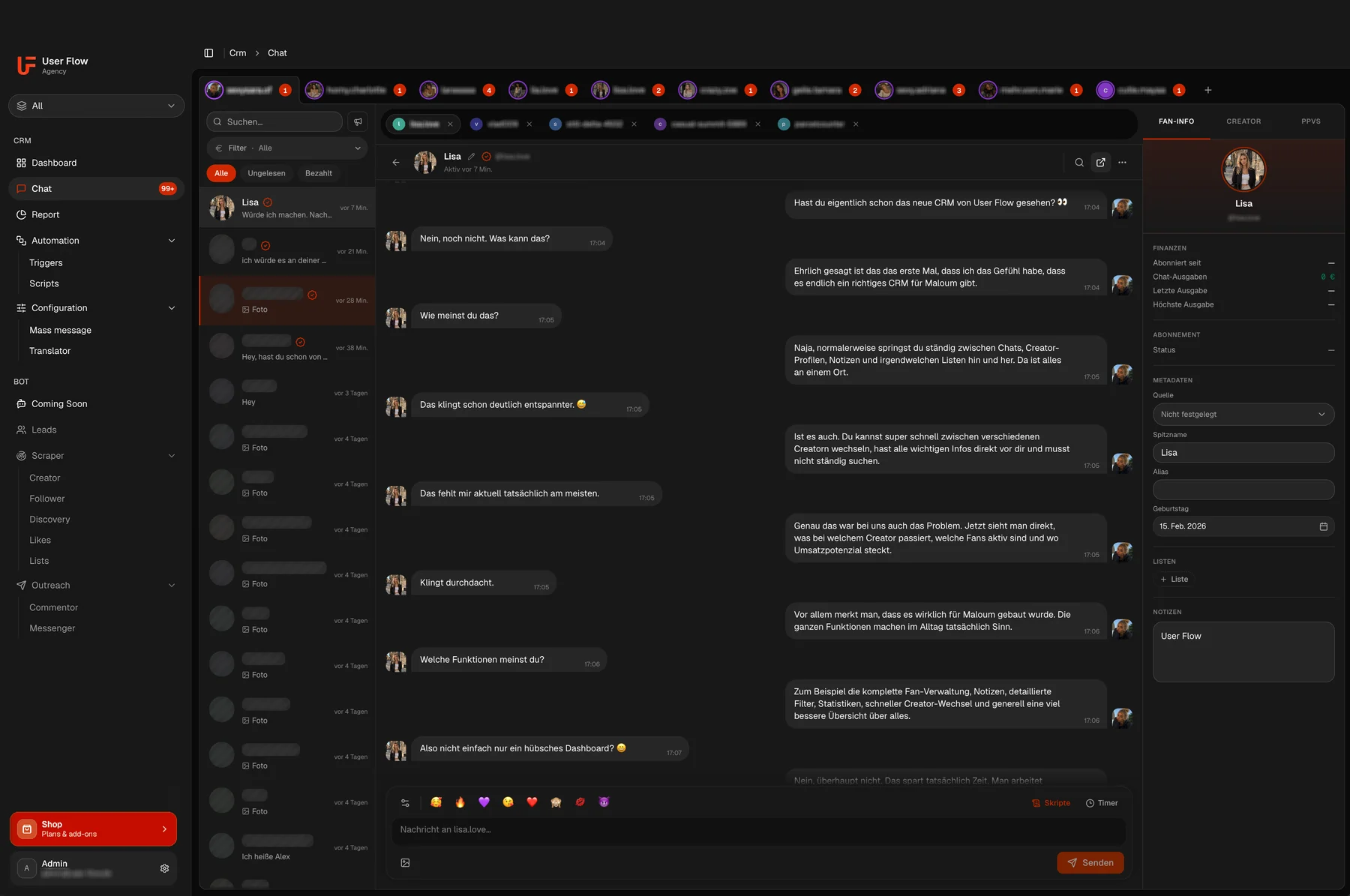
UserFlow is the CRM built for exactly this use case: fan management, chatter coordination and follow-up automations in one system instead of spread across spreadsheets, Telegram groups and head knowledge.
That means: every fan has a central record with purchase history and context. Chatters see what they need to know before they write. Automations run without manual follow-up. And when a second account joins, it builds on the same foundation.
CRMFan context for every chatter
Purchase history, last contact, price threshold, stored centrally, visible to all chatters. No head knowledge, no lost info when a chatter changes.
AutomationFollow-ups that run automatically
Define follow-up chains that are triggered when a fan buys, doesn't reply or exceeds a certain time window, without manual coordination.
BotOutreach and welcome messages
New subs are greeted automatically and added to the CRM system. The Bot starts the fan lifecycle before the chatter takes over.
SystemScalable across multiple accounts
Once the system runs on account #1, it can be transferred to account #2, without rebuilding everything. That's the difference between growth and more chaos.
The CRM for Maloum agencies.
Fan management, automations and chatter coordination in one system. Join the waitlist and secure early access.
Ready to put this to work in your agency?
CRM, Bot and Translator in one tool – built for Maloum and 4Based agencies. Start now for free, no risk.
Frequently asked questions about chat revenue
Why does so much revenue happen in the chat?
Because the chat is the only place where a fan builds a personal relationship with the creator. PPV, custom content and renewals come almost exclusively from targeted chat communication, not from feed posts.
What is the most common mistake with chat revenue?
No fan context. Whoever doesn't know what a fan has bought, how often he writes and what he is interested in improvises. Improvisation costs revenue. Systematic fan context is the foundation of every revenue strategy in the chat.
What is the difference between a high and a low PPV purchase rate?
Agencies with a high purchase rate know their fans. They know when the fan last bought, what his price threshold is and how he wants to be messaged. Agencies with a low purchase rate send the same PPV to everyone, without segmentation, without timing, without context.
Do I need a CRM to increase my chat revenue?
Yes, sooner than most think. Without a CRM you have no context about your fans. Without context, your chatters improvise. Improvisation leads to low purchase rates. A CRM is the technical foundation for systematic chat revenue.
How do I optimize my chat revenue specifically?
Three levers: build fan context, define a clear chatter strategy and automate follow-ups. All three need a system, they don't work as standalone measures and can't be mapped with spreadsheets and Telegram.
How quickly does chat optimization affect revenue?
Faster than any other lever. Content optimization works over weeks. Chat optimization can become measurable within a few days, because it acts directly at the point of purchase, not at the point of attention.