





Why the model steers more than the amount
How to find, train and monitor chatters is covered in Building a Chatter Team: Recruiting & Control. What that article deliberately only touches is the question with more day-to-day impact than any training: how you pay them. Not how much, how.
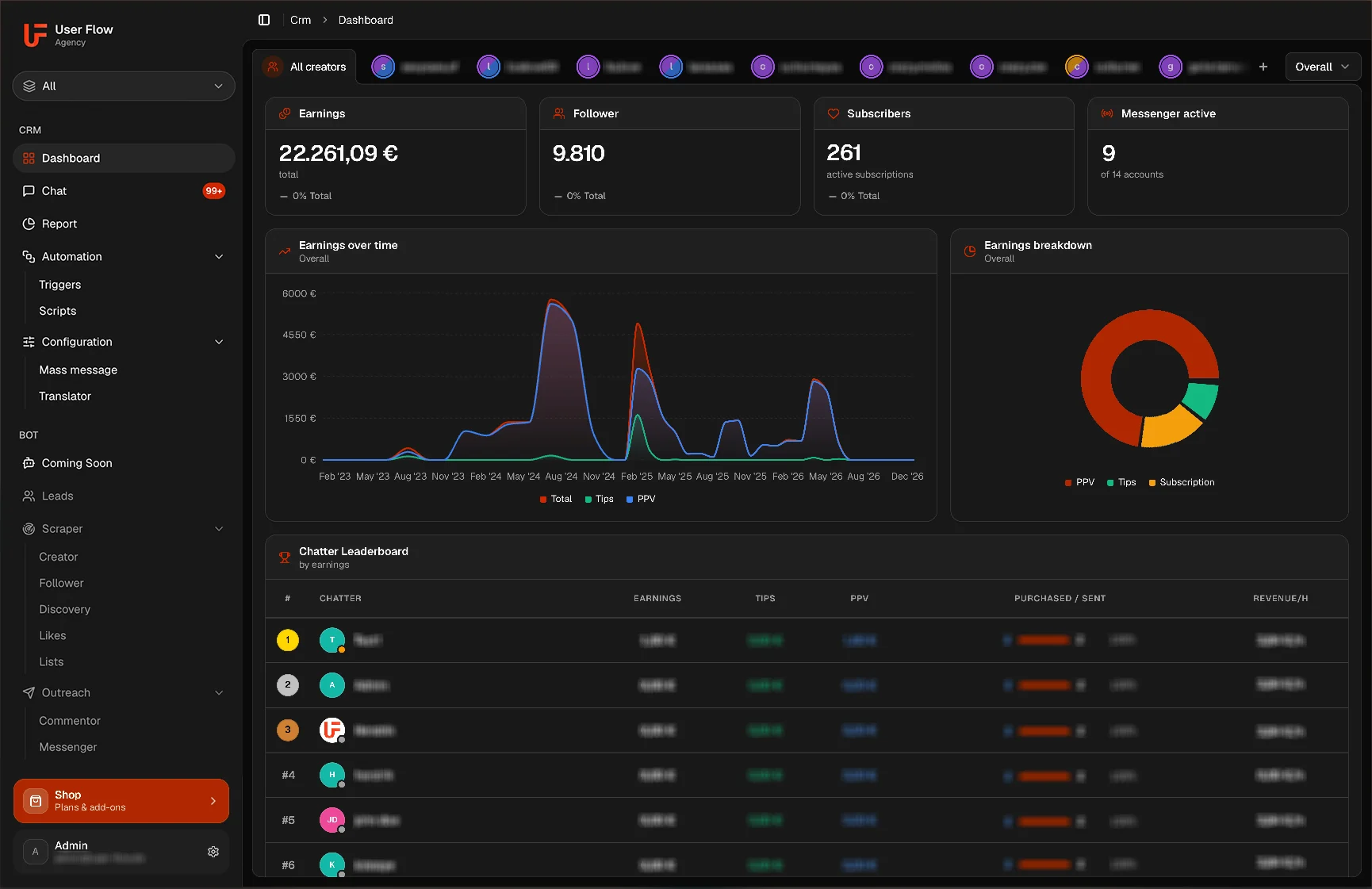
The UserFlow CRM provides the per-chatter, per-shift numbers a fair commission model rests on.
Because a pay model does not determine what someone earns. It determines what they do when nobody is watching. Every formula rewards a specific behaviour, and that behaviour is exactly what you get, including when you did not want it. Pay for revenue and you get revenue, including the kind that will be missing tomorrow. Pay for hours and you get hours, including the empty ones.
So the right question is not "what is standard" but: which behaviour do I want in this shift, with this fan, this month? The percentage comes after that. The usual ranges are quickly told anyway, 10 to 20 percent of self-generated revenue on pure commission, a fixed base plus commission for people who are meant to stay. That is the easy part.
The three models and what they actually reward
Pure base pay: rewards presence
Hourly or monthly, independent of results. The advantage is predictability on both sides: you know what the month costs, the chatter knows what they get. The drawback is just as clear, there is no reason to make more out of a conversation than necessary. As the main model for revenue shifts this is the most expensive option. For shifts where there is little to be had anyway it is the only one that works: night coverage, weekend duty, looking after existing fans. Nobody takes a low-potential shift when their income depends on it.
Pure commission: rewards the close
A share of self-generated revenue, usually 10 to 20 percent. For the agency the lowest-risk form: it costs nothing when things are quiet and scales when they are not. The catch sits in the word "close". What gets rewarded is the sale today, not the fan who is still there next month. So you are paying for exactly the behaviours that cost money elsewhere: selling too early, pushing the price down, working a fan until he goes quiet. Use commission as your only instrument and you get a good buy rate and poor retention, then wonder about the second half.
Base plus commission: rewards both
A base amount that carries the presence, plus a share of what comes out of it. This is the common model for people who are meant to stay, and it costs more when things are quiet, in exchange it is the only one of the three that pays for two things at once: being there and selling. The ratio is what matters. Too high a base and the incentive disappears; too low and it is decoration, leaving you with a commission model plus extra cost.
You are not choosing a model for the agency, you are choosing one for a shift. Strong evening shifts can carry a high commission share. Night shifts and relationship work need a base, or nobody will take them. Both under one roof is not a contradiction, it is the normal case.
The question it actually fails on
In practice commission models almost never break over the percentage. They break over a question nobody asked in advance: who owns the revenue when three chatters have written to the same fan?
The fan was built up by one, kept warm for weeks by a second, and bought during the third one's shift. Who gets the commission? There are three common answers, and all three have a downside worth knowing:
The last one gets everything
Simple to settle and therefore the most widespread. The price is a behaviour that sets in quickly: nobody invests in build-up work whose return somebody else collects. Instead people wait for the warm fans, and the cold ones are left lying.
Split by chat time
Fairer and considerably more work. It assumes you actually know who wrote to which fan for how long. Without that data it is an estimate, and estimated payouts create more argument than no rule at all.
Split by shift
The compromise: the revenue belongs to the shift it happened in, regardless of who did what beforehand. Over a month that evens out, as long as the shift distribution is fair. Which is exactly why shift planning becomes a pay question here, whoever always gets the weak slots earns less permanently without being worse.
Which of the three you pick matters less in the end than that it is settled in advance and in writing. A mediocre rule everyone knows beats a fair one invented during the first dispute.
You get what you pay for
Four side effects turn up so reliably that they work as a diagnostic tool. When one of them appears, it is rarely the team's fault.
Nobody wants the night shift
On pure commission that is not laziness, it is arithmetic: the weakest hours earn the least. If you want the coverage you have to pay for it, through a base for that shift or a higher rate. Not through appeals.
New fans are left lying
A new fan is work with an uncertain outcome, an existing one is probable revenue. Reward only the close and everyone behaves rationally, and nobody works the start of the relationship any more.
Nobody asks for the sale
The counterpart under pure base pay. The conversations are pleasant, the buy rate is flat. That is not a motivation problem either but the predictable result of a formula in which selling changes nothing.
Discounts only cost the agency
When commission is calculated on the revenue achieved, a reduction is nearly painless for the chatter, it sells more easily and costs them only a fraction. The agency carries the full discount. Anyone who wants to limit discounts has to put that in the formula, not in a rule nobody remembers.
The two numbers without which you are guessing
You cannot sensibly choose a model while you only know total revenue per chatter. That mostly tells you who had the better shifts. Two other numbers say something about the person:
Revenue per hour. This is the only figure that makes chatters comparable across different shifts. Someone making 40 euros an hour on nights may well be better than someone on 90 on a Saturday evening. Without that normalisation you systematically reward the convenient slot.
Purchased to sent. The buy rate shows the quality of the approach, independent of how much someone sent out. A chatter with 200 offers sent and a weak rate costs you more than their revenue figure suggests, they are burning through fans. What drives that rate and what ruins it is in Maloum PPV: Buy Rate Below 20 %?
With those two values the model question becomes arithmetic: you can see from which hourly revenue a base pays for itself, and you can tell who would genuinely benefit from a higher commission share. Without them you pay by impression, and impressions tend to follow whoever talks loudest about their good evenings.
Revenue per hour and buy rate per chatter.
CRM, bot and translator for Maloum and 4Based, with a leaderboard that makes people comparable across every creator.
Setting it up without changing it three times
A pay model tolerates few changes before it loses credibility. Every adjustment gets read as a cut, even when it is not. Four things help to make it durable the first time.
Measure first, pay second
Never let a model loose on assumptions. Two or three weeks of clean numbers show you where your team actually stands, and stop you fixing a rate you have to claw back after the first month.
One variable at a time
Changing the commission rate, the base and the attribution rule at once means not knowing afterwards what worked. One change, then wait at least one full payout period.
A floor, not the main pay
If you use a base, use it as protection against weak shifts, not as a replacement for the incentive. A low, reliable floor binds good people far more than a high rate that leads nowhere in bad weeks.
In writing, before the first month
Rate, basis, attribution rule, payout date, handling of chargebacks. Five lines are enough. Whatever is missing here gets reconstructed later from memory, and memories diverge.
One note that goes beyond this article but belongs with it: whether your chatters are employed or self-employed is not a question of the pay model but of the actual working relationship, fixed shifts, instructions and integration point towards employment. What applies in your case is settled with a tax adviser or a lawyer, not with a blog article. The formula on top can be built the same way either way.
Choose the model per shift, not for the whole house. Settle in writing beforehand who owns the revenue when several people worked the same fan. And measure revenue per hour and buy rate before fixing a rate, otherwise you are paying for the shift slot instead of the performance.
Frequently asked questions
How much commission does a chatter usually get?
On pure commission, 10 to 20 percent of self-generated revenue is common. People who are meant to stay longer more often get a fixed base plus a lower commission share. More important than the rate is the basis: does it count revenue achieved or revenue before discounts, and what happens with chargebacks.
Base pay or commission, which is better?
That depends on the shift, not the agency. High-revenue hours can carry a large commission share because there is something to be had. Night shifts and looking after existing fans need a base, or nobody takes them voluntarily. Both models side by side in the same team is the normal case, not a contradiction.
Who owns the commission when several chatters worked the same fan?
There are three common rules: the last one gets everything, simple, but then nobody invests in build-up work. Split by chat time, fairer, but it assumes you know the times. Or split by shift, which evens out over a month provided the shift distribution is fair. What matters is that the rule is settled in advance and in writing.
Why does nobody want the night shift on pure commission?
Because the weakest hours earn the least. That is not laziness, it is arithmetic. If you want round-the-clock coverage you have to pay for it, through a base for that shift or a higher rate. Appeals do not change the maths.
Which numbers do I need to settle on a model?
Two: revenue per hour and the ratio of purchased to sent. Total revenue per chatter mostly tells you who had the better shifts. Only per hour do people become comparable across different times, and only the buy rate shows the quality of the approach independent of volume.
How often should I change the pay model?
As rarely as possible. Every adjustment gets read as a cut, even when it is not. If you do change it: one variable at a time, wait at least one full payout period, and announce the change rather than letting it show up in the next statement.