





The cancellation is the end, not the beginning
Almost every agency watches one number: how many subscriptions are running. When it drops, someone reacts. The problem is the timing. By the time a fan cancels, the decision is weeks old, it was made quietly at some point before, without warning, and nobody noticed. The cancellation is merely the moment it becomes visible.
Every fan’s purchase history, where these signals show up first, sits right next to the chat in the UserFlow CRM.
So the most expensive fan is not the one who cancelled. It is the one who still pays and is already gone. He is still in the statistics, he costs no attention because he causes no trouble, and that is exactly why nobody looks at him. Six weeks later he is gone, and everyone says he "just dropped off".
Why that weighs more than it sounds: an existing paying fan is the only income that cost no acquisition. He was not recruited, not convinced, not warmed up. Lose him and the revenue has to be earned again somewhere else, with reach, time and chat effort, all of which cost something. Retention is therefore not a side topic next to selling. It is the cheaper half of it.
The four signals that come first
Here lies the decisive difference to the question of who gets which message. For a single sales decision what counts is a fan's state, does he write, does he buy. For churn something else counts: the change compared to before. A fan who has always been terse is not a warning sign. A fan who has become terse is.
1. His reply time gets longer
Not yours, his. Someone who used to answer within the hour and now takes a day has shifted his priority. That rarely happens deliberately, which makes it a more honest signal than anything he says.
2. His answers get shorter
Sentences become words, words become emoji. The fan is still polite, but he no longer carries the conversation. Selling faster at this point, instead of asking more slowly, only speeds up the exit.
3. He still looks but no longer buys
The most expensive state of all, because it looks like interest. Usually it is habit: the fan opens because he always has, and does not buy because nothing surprises him any more. Waving this away with "well, he is still active" means losing him in the next billing period.
4. He only responds to discounts
When a fan buys nothing at full price but takes every reduction, the relationship has already turned into a question of price. That is fixable, but not with the next discount, see below.
A single signal means nothing, people have busy weeks. Two at the same time are an appointment: that fan needs to be approached within days, and without an offer.
The three reasons actually behind it
If you could ask fans, "too expensive" would rarely come up. What actually happens boils down to three patterns, and none of them is a mistake in the classic sense.
Repetition
The most common reason, and the least conspicuous. In month four the fan gets the same approach, the same kind of content and the same offer as in month one. Nothing broke, nothing new simply happened. To the agency that feels like stability, to the fan it feels like standstill. That is the point where a subscription turns from a decision into a direct debit, and direct debits eventually get noticed on a bank statement.
The break in the voice
A chatter handover done badly is not an organisational detail to the fan, it is a break in mood. Suddenly the writing is different, familiar things are forgotten, the tone is off. He usually cannot name what changed, but he feels it immediately, and hardly anyone comes back from that break. How to set up team changes so they do not carry through is in Building a Chatter Team: Recruiting & Control.
Too much selling, too little conversation
When every second message contains an offer, the relationship is a sales channel. People end sales channels without a second thought, with a person they hesitate. That is not a moral point but an economic one: the reluctance to cancel is the actual retention mechanism, and it is built exclusively in the messages that sell nothing.
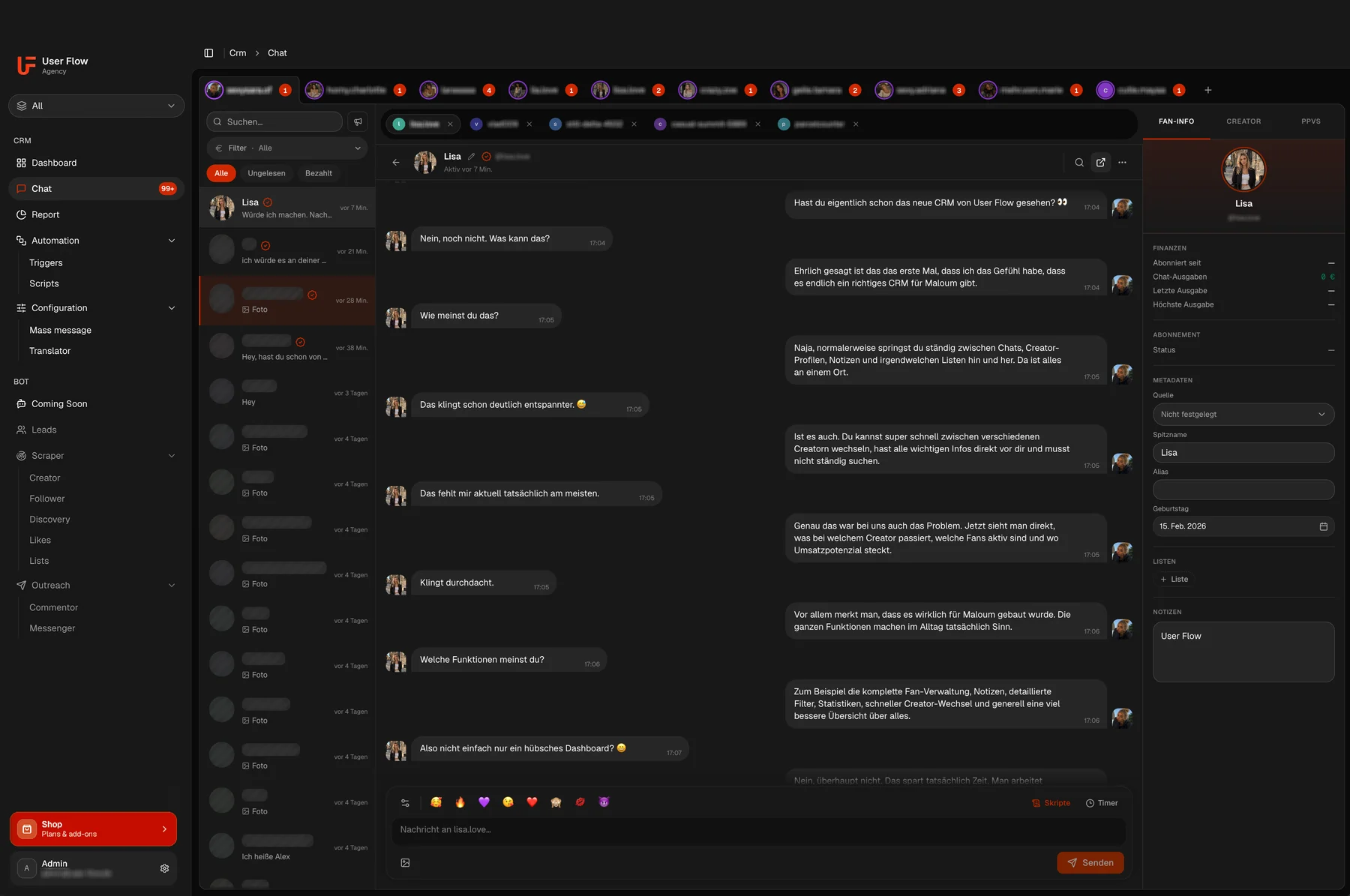
See which fan is going quiet right now.
Last purchase, last reply, spending history and notes per fan, for Maloum and 4Based in one system.
What does not work
Three reflexes are as widespread as they are harmful. All three feel like taking action and all three speed up the exit.
The discount as a first answer
Cutting the price at the first sign answers a question the fan never asked. Worse, it teaches him that going quiet makes things cheaper. That is exactly how signal number four above comes about, a fan who only responds to reductions because he has learned that waiting pays off. A discount can stand at the end of a win-back. At the start it ruins one.
The "we miss you" broadcast
It is recognisable as a mass message, and it confirms precisely the impression that made the fan go quiet: that he is one of many. An automated message against the feeling of being treated automatically is a contradiction the recipient spots instantly.
Simply writing more
Where relevance is missing, frequency does not replace it. Three messages a day to someone who has not replied in a while turn disinterest into annoyance, and that is the shortest route to a cancellation there is.
What can work
There is no method that keeps every fan. But there are three things that make the difference while something can still be saved.
The first message must sell nothing
No offer, no reduction, no scarcity. A real question that makes an answer possible. The goal of this message is not revenue but a reply, only once the conversation is running again is there anything to sell. Reverse that order and you get neither.
It has to reference something specific
Something this fan said. A plan, a date, a topic from three weeks ago. That is exactly what separates a win-back from a broadcast, and it requires that somebody wrote it down. Without notes this step is simply not possible, however good the chatter is.
The moment is before the cancellation, not after
While the fan is still paying, reaching out is care. After the cancellation it is acquisition, with markedly worse odds and usually with the aftertaste that somebody only got in touch now. Reacting only to cancelled subscriptions means always working in the most expensive phase.
And for completeness: some people simply leave. Circumstances change, so do interests. Trying to keep everyone ties up time that is worth far more spent on the fans showing two signals. Not every departure is a failure, but every unnoticed one is a missed opportunity.
What you need to see for this
The subscription count is no use for this question. It shows the result once nothing can be changed, and it shows it without names. What you need per fan instead are three figures:
Days since the last reply · days since the last purchase · the trend of his spending across the months. All three per fan, not as a total, totals hide exactly the movement that matters here.
The trend is the most important of the three and the one least often looked at. A fan who has fallen from €80 to €20 a month is a bigger loss than three who never paid more than €10, and he does not show up in the subscription count at all, because his subscription is still running. He has already left by three quarters, only nobody wrote it down.
On top of that comes the basis for everything else: notes that survive a change of chatter. Without them every win-back message is generic, and generic is the reason the fan went quiet in the first place. How to bring chat and fan data together so both sit in one place is in Bot & CRM: What to Automate and What Not.
Frequently asked questions
Why do fans cancel their subscription?
Rarely because of the price. Three patterns explain most cases: repetition, month four brings the same approach as month one. A break in the voice, usually after a chatter change without a handover. And an excess of selling over conversation, which turns a relationship into a sales channel that gets ended without a second thought.
How do I spot a fan who is about to leave?
By the change, not the state: his reply time gets longer, his answers get shorter, he still looks but no longer buys, and he only responds to discounts. A single signal means little, people have busy weeks. Two at the same time are an appointment.
Does a discount help to keep a fan?
Not as a first reaction. It answers a question the fan never asked and teaches him that going quiet makes things cheaper, after which he only responds to reductions. A discount can stand at the end of a win-back, once the conversation is running again. At the start it ruins one.
When should I approach a quiet fan?
While he is still paying. Then it is care; after the cancellation it is acquisition, with worse odds and the aftertaste that somebody only got in touch now. Concretely: as soon as two of the four signals appear together, not when the subscription is about to lapse.
Is it worth winning back fans who already cancelled?
It is possible, but considerably more work than care beforehand, and the success rate is lower. Given the choice, put the same time into the fans showing two warning signals, the ratio of effort to result is better there. And some simply leave because circumstances change; that is not a fault to be repaired.
Which numbers do I need to see churn early?
Three per fan: days since the last reply, days since the last purchase and the trend of spending across the months. The subscription count alone is not enough, a fan who has fallen from €80 to €20 is already mostly gone but does not appear there, because his subscription is still running.