





Chatter management is a handover problem
How to find chatters, train them and make their performance measurable is covered in Chatter team: recruiting and control, and how to pay them in Base, commission or both. This article deals with what comes after that and costs the most revenue day to day: the organisation between people.
Who holds which chat right now and what is still open at handover is visible in the OnlyFans CRM.
Because a chatter team rarely fails because somebody cannot write. It fails because three people talk to the same fan one after another and none of them knows what the others said. The fan notices immediately. Yesterday he mentioned a custom video, today somebody asks the same thing again, and a conversation that was close to a purchase starts over from the beginning.
On OnlyFans this hits you harder than elsewhere, because your audience is not in your time zone. A German-language account manages with two shifts. An account with US fans needs coverage while it is night where you are, and therefore inevitably more handovers per fan. If you are only just building an agency, the groundwork is in Starting an OnlyFans agency.
The shift plan: the hours that actually matter
Most shift plans are built from availability, who can work when. That is understandable and still the wrong order. First you define which hours have to be covered, then you look for the people to cover them. The other way round you get a plan that fits your team rather than your fans.
Which hours those are is in your own numbers: when messages come in, and when people buy. Those two curves are not the same. There are hours with a lot of activity and little revenue, and hours with few but ready-to-buy fans. The second kind is the expensive one when it is unstaffed.
What works in practice:
- Fixed shift boundaries instead of sliding transitions. If nobody knows exactly when they take over, you get twenty-minute gaps where nobody feels responsible.
- An overlap of ten to fifteen minutes between two shifts. That is the time for the handover, without it, it does not happen.
- The same person on the same shift wherever possible. Someone who always works evenings knows their fans. A rotating plan turns every chatter into a stranger.
- A named stand-in per shift, not "we will see". Absences happen, and they always happen at short notice.
An unstaffed hour appears in no report. You see the revenue you made, never the revenue that did not happen because nobody replied for two hours. That is why the shift plan has to come from the fan hours and not from gut feeling.
The handover: what the next shift needs to know
This is where most agencies lose money, and it never registers as a mistake, because nothing breaks, things simply fail to happen.
The common solution is a message in the team group at the end of a shift. It works with one account and collapses with three: what was written at 11pm is thirty messages further up by 3am, and whoever starts a shift does not scroll. A handover you have to search for is not one.
What a usable handover contains
Not what happened, but what is open. That difference decides everything: nobody reads a summary of the evening, but people do read a list of open items. Concretely that is four things, which fan was promised what and by when, who has an unanswered message, where a sales conversation is currently running, and who is irritated or unhappy right now. Everything else can wait.
Where it has to sit
On the fan, not in the group. A note on the fan profile is there when the next chatter opens the conversation, exactly at the moment they need it. A message in a group is there when nobody is looking. That is the whole difference, and it decides whether handovers actually happen or are merely agreed on.
Ownership: who handles whom, and when to hand off
The second question that has to be settled in advance: does a fan belong to the shift or to a person?
The fan belongs to the shift. Whoever is on duty writes. Easy to plan, scales well, and coverage has no gaps. The price: nobody builds a relationship, because nobody stays long enough. For fans who mainly want to buy, that is enough.
The fan belongs to one chatter. A fixed contact who knows the fan over months. Considerably stronger with the big spenders, and the reason many agencies run their best fans this way. The price: the fan is unattended when that person is off, and you have a problem if they quit.
In practice it runs mixed: the big spenders get a fixed contact, the rest get the shift. What matters is only that everyone knows which fan falls into which category, otherwise two people write at the same time and the fan sees two different personalities.
When a chatter has to hand off
Three cases should be defined in advance, because they are hard to judge in the moment: a chargeback or payment complaint, a fan who threatens or turns abusive, and any request for the creator's personal details. In all three the chatter does not keep replying but hands off. If that is not settled beforehand, somebody improvises at three in the morning, and improvised answers in exactly these cases are the ones that get expensive later.
What to check while things are running
Performance metrics per chatter are covered elsewhere. Day to day you need something different: samples, not statistics. Numbers show you that something is wrong, they never show you why.
What has proven itself is small and regular: once a week, read two or three complete conversations of a chatter from start to finish. Not the highest-revenue ones, but randomly chosen. In five minutes that reveals things no report contains, that somebody sells too early, that promises are made which nobody keeps, that a fan has been asking the same question for three weeks.
Second: response time in the fringe hours. Not the daily average, which always looks fine. The longest wait in the weakest shift. That is the number that tells you whether your shift plan holds or only exists on paper.
Where all of this is kept
Everything up to here can be handled with a spreadsheet and a group chat, and that is exactly what most people do. It works with one account and two chatters. It breaks as soon as several people work at the same time, because the three things that matter then sit in three different places: the shift plan in a spreadsheet, the handover in the group chat, the fan history in the head of whoever is currently off.
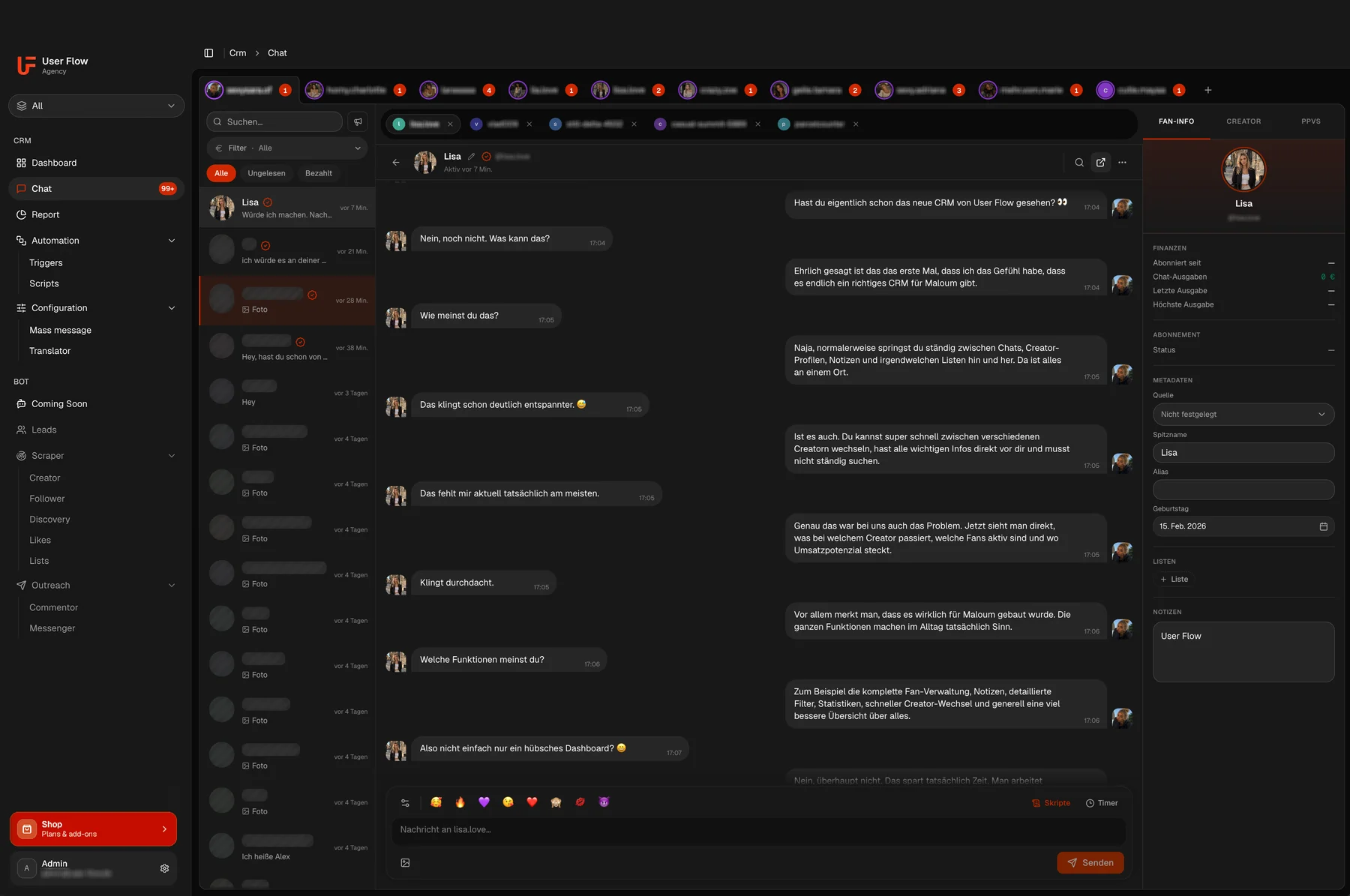
What is needed is unspectacular: the note on the fan rather than in the group, the history visible to whoever writes next, and one view across all creators instead of one file per account. Why standard tools fail at this is covered in Why standard tools fail.
So the handover sits where the writing happens.
Fan notes and history right beside the conversation, buy rate per chatter and every creator in one view, for OnlyFans. The bot runs on Maloum and 4Based. Everything is €0 during the beta.
Frequently asked questions
How do I organise a chatter team across time zones?
The shift plan comes from the fan hours, not from the team's availability. First you define which hours have to be covered, for that you need two curves, when messages arrive and when people buy, because those are not the same. Only then do you look for people. The other way round produces a plan that fits the team rather than the fans.
What belongs in a shift handover?
Not what happened, but what is open. Concretely four things: which fan was promised what and by when, who has an unanswered message, where a sales conversation is running, and who is unhappy right now. Nobody reads a summary of the evening, but people do read a list of open items.
Why is a group chat not enough for handovers?
Because a handover you have to search for is not one. What was written at 11pm is thirty messages further up by 3am, and whoever starts a shift does not scroll. The information has to sit on the fan, where the next chatter sees it when they open the conversation, not where nobody happens to be looking.
Should a fan belong to a fixed chatter or to the shift?
Both have a price. If the fan belongs to the shift, coverage has no gaps but nobody builds a relationship. If he belongs to a fixed chatter, the bond is considerably stronger, but the fan is unattended when that person is off, and you have a problem if they quit. In practice it runs mixed: fixed contacts for the big spenders, shift coverage for the rest.
When does a chatter have to hand off a conversation?
Three cases should be defined in advance, because they are hard to judge in the moment: a chargeback or payment complaint, a fan who threatens or turns abusive, and any request for the creator's personal details. If that is not settled, somebody improvises at three in the morning, and exactly those improvised answers get expensive later.
How do I check quality day to day?
With samples, not statistics. Reading two or three randomly chosen conversations in full once a week shows in five minutes what no report contains: selling too early, promises nobody keeps, unanswered questions. Add a single number, the longest wait in the weakest shift. The daily average always looks fine and tells you nothing.