





What runs better than expected on Maloum
These three points come up almost every time agencies take stock after a few months.
The Maloum CRM page shows the tool agencies use to run their Maloum accounts.
The audience buys differently
A German-speaking audience responds more to closeness and reliability than to volume. That sounds soft but has a hard consequence: fans stay longer and buy repeatedly instead of paying once and vanishing. For agencies that shifts the focus away from constantly hunting new fans towards maintaining existing chats.
The commission is fair and predictable
Maloum keeps 20% of creator revenue, the same ballpark as OnlyFans. More important than the rate is the predictability: you can calculate your margin cleanly without factoring in shifting extra costs. The full comparison of both platforms is in Maloum vs. OnlyFans for Agencies.
Reach does not depend on external traffic alone
Anyone coming from platforms where nothing happens without an outside ad budget is surprised that some fans arrive on the platform itself. It does not replace building your own reach, but it noticeably lowers the barrier to entry for smaller agencies.
What almost everyone underestimates in year one
None of these three has anything to do with the platform, they come with your own growth. Knowing them early saves you an expensive learning curve.
Fan knowledge leaves with the chatter
What a fan likes, what they last bought, what they react badly to: that knowledge is created in the chat and stays in the head of whoever wrote there. When they leave, it is gone. Agencies do not notice on the day of the resignation but three weeks later, in falling purchase rates, and then blame the new chatter.
Quality swings between shifts
The same fan gets an attentive chatter in the morning and someone starting from zero in the evening. To the fan that reads as disinterest, and disinterest ends willingness to pay faster than any overpriced PPV. How to build a team that holds up is in Building a Chatter Team on Maloum: Recruiting, Training, Control.
Coordination eats more time than chatting
From the second account onwards, many agency owners spend more time on check-ins, follow-up questions and hunting down numbers than on the actual business. That is the point where growth suddenly feels like going backwards, even though revenue is rising.
All three have the same root cause: knowledge and responsibility sit with people rather than in a process. As long as that is true, every additional person scales the problem instead of solving it.
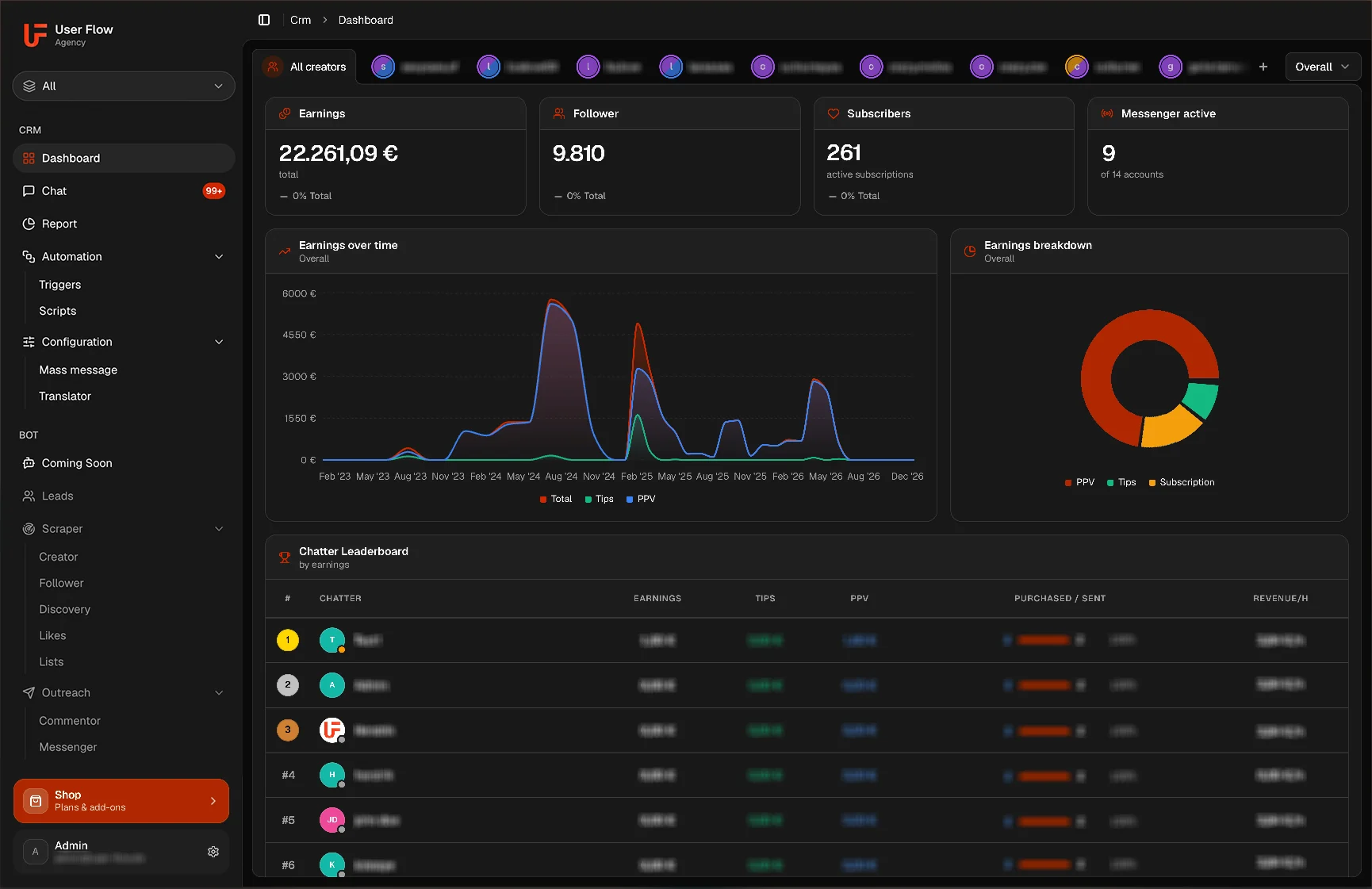
So your fan knowledge does not walk out with the chatter.
CRM, bot and translator work together: fan history central, shifts traceable, performance visible.
What the agencies where it works do differently
The difference is remarkably unspectacular. It is not better creators and not harder-working chatters.
They treat chat as a process, not as talent
In these agencies it is defined what happens at handover, where fan information goes and how a good shift is measured. A great chatter does not become redundant, but an average one suddenly delivers reliably instead of by chance.
They see their numbers daily, not monthly
Revenue per chatter, purchase rate, response time. See those only at month end and you correct four weeks too late. See them daily and you notice on day three that a shift is slipping, while fixing it is still cheap.
They automate the supply, not the conversation
Finding and messaging new users is grunt work and belongs automated. The conversation itself does not: fans notice immediately when nobody is listening any more. Successful agencies draw that line very sharply. What the bot can do and where its limit is sits in Maloum Bot: Automation & Strategy.
They build the structure before the growth
Not after the fifth account, but before the second. It is the most frequently given piece of advice from agencies who have that phase behind them, and simultaneously the one newcomers follow least. The full setup is in Maloum System: The Complete Setup for Agencies.
Our verdict after many Maloum agencies
Maloum is a first-rate foundation for German-speaking agencies: a fair and predictable commission, an audience with real willingness to buy, and an entry small teams can manage.
And the biggest lever is handed straight to you: around 80% of revenue happens in chat. How much you get out of Maloum is therefore mostly your call, decided by the system you build behind it.
Maloum supplies the foundation: fair commission, an audience ready to buy, direct access to fans. What you make of it is decided by your system, fan knowledge central, shifts handed over cleanly, numbers in view daily.
Ready to put this into practice in your agency?
CRM, bot and translator in one tool – built for Maloum and 4Based agencies. Start free, no risk.
Frequently asked questions
What are agencies' experiences with Maloum?
Consistently positive. What gets praised is the German-speaking audience with real willingness to buy, the fair 20% commission and the direct access to fans on the platform. Usually only one thing gets underestimated: the workload in chat. Around 80% of revenue happens there, and that is where it is decided how much you make of the platform.
How high is the commission on Maloum?
Maloum keeps 20% of creator revenue, the same as OnlyFans. For agencies the platform commission is therefore not the deciding difference between platforms, how much revenue per fan actually happens in chat is.
What do agencies underestimate most on Maloum?
Three things: how fast fan knowledge disappears once a chatter leaves, how much quality swings between shifts, and how much time pure coordination eats once more than one account is running. All three only become visible when you grow, but they cost revenue from day one.
Is Maloum worth it for small agencies?
Yes, especially there. Small agencies benefit from the German-speaking audience and from the fact that reach on Maloum does not come exclusively from paid external traffic. The downside for small teams is not the platform, it is that any absence hits immediately.
What do successful Maloum agencies do differently?
They treat chat as a process rather than as talent. Fan data sits centrally instead of in people's heads, every shift has a clear handover, new users arrive automatically instead of manually, and performance per chatter is visible. That is the difference between agencies that grow and agencies that stall at three accounts.