





The chat scales. The traffic does not.
What a system carrying several accounts looks like, and which growth phases an agency goes through, is covered in Scaling an agency: the system from account 1. On OnlyFans there is an additional limit that does not exist there, and it decides how far you get at all.
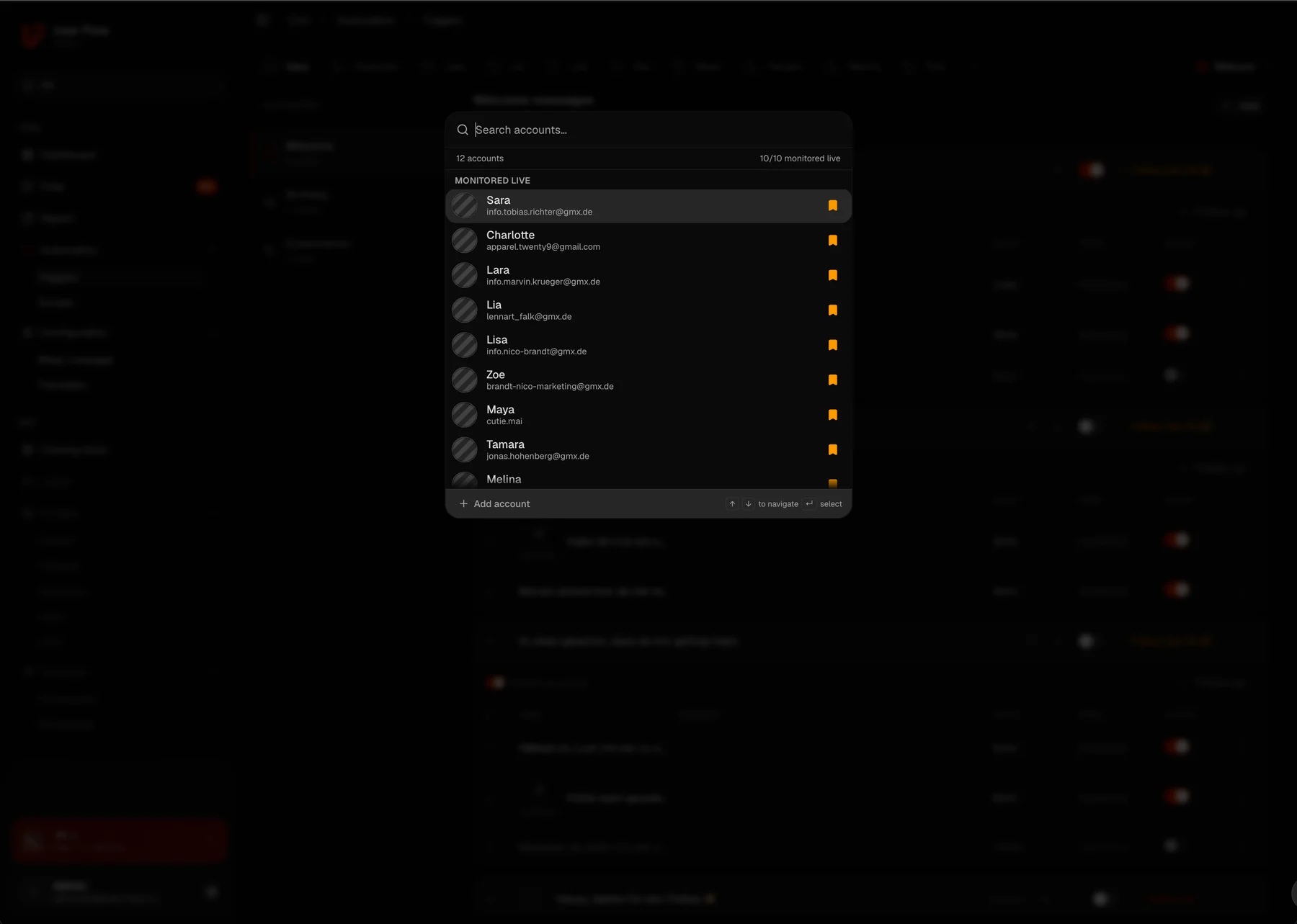
More creators without chaos means, in practice: every account in the OnlyFans CRM instead of separate browser profiles.
The chat can be made bigger by hiring. More fans mean more messages, more messages mean more chatters, and that works linearly as long as you find people and pay them. That part of the business is laborious but solvable.
Traffic behaves differently. Because the platform has no discovery function, every new creator needs their own reach from outside, their own Reddit presence, their own X account, their own posts. That cannot be pooled: five creators need five presences, not one bigger one. Overlook it and you hire chatters and then wonder why the inboxes stay empty.
The bottleneck moves, predictably
Growth feels chaotic but follows a pattern. At each step up a different point breaks first, and knowing which one lets you prepare it instead of repairing it.
One creator: time
The bottleneck is you. Everything depends on your availability, and the limit is reached when you stop replying at night. That is solved by a second person, not by a system.
Two to three creators: information
Here the knowledge breaks first. Nobody can say any more what a fan was promised or which chatter wrote last. That is where a spreadsheet and a group chat stop carrying, described in OnlyFans CRM. Making this step without a system means working against yourself from then on.
Four to six creators: traffic
Now the limit from the first section bites. Chat capacity can still be increased, but nobody keeps up with producing daily posts for six accounts. This is where most agencies stall, not because of the chat, but because the supply runs out.
Seven and up: leadership
The last bottleneck is the most uncomfortable, because it is about you. At that size you no longer know every chatter and every case. You need somebody between you and the team, and numbers telling you where to look, because you can no longer look everywhere.
At every step up, people invest where it last hurt. Somebody who had an information problem at three creators buys another tool at six, although the bottleneck has long been traffic. Before every hire and every purchase, ask which of the four bottlenecks is actually binding right now.
What can be copied, and what cannot
Scaling essentially means the next creator costs less effort than the last. That only works for the things that transfer, and the split is sharper than most people assume.
The processes transfer. How a creator is taken on, which questions the briefing asks, what a shift handover looks like, which numbers get checked weekly. You write that down once and use it identically the twelfth time. If every intake is improvised, the fifth creator costs as much as the first, see Creator onboarding.
Text blocks and limits transfer too, but only as scaffolding. The tone belongs to the individual creator and has to be set per account, otherwise everyone sounds the same, and fans subscribed to two of your accounts notice.
Reach does not transfer. An established Reddit presence does not help the new creator, because it is tied to a person. What you can transfer is the knowledge of which channels carry in which niche and what the rules are, the work itself starts from scratch each time. That is the real reason growth is more expensive on this platform than elsewhere.
Two ways to grow, and one is cheaper
Growth is almost always imagined as "more creators". But there is a second route, and in most agencies it is the cheaper one, especially at the point where traffic becomes the bottleneck.
More creators means: new acquisition, new onboarding, new traffic built from zero, additional chat capacity. Each of those costs, and building traffic costs the most, because it cannot be shortcut. How to reach new creators is covered in OnlyFans recruiting.
More from the same creators means: better buy rates, fewer quiet fans, longer retention. That needs no new traffic and no new acquisition, it needs somebody to notice when a fan has not bought anything for four weeks. How to spot that in time is covered in Why fans stop paying.
The arithmetic is often clear-cut: ten percent more buy rate across all existing accounts is usually cheaper to achieve than one additional creator, and it takes effect immediately, while a new account needs months before it carries. Attempting both at once is the most expensive route, because then neither gets the attention it needs.
How you notice you are growing too fast
Growing too fast looks like success from the outside and does not announce itself as an error. Four signs reliably appear before revenue drops, and all four are visible early.
- A creator gets in touch because they noticed something. The signal is not what they say but that they had to notice it. At a manageable size, that sort of thing reaches you first.
- Response time rises in the fringe hours. The daily average still looks fine, the weakest window does not. That is the first measurable crack.
- New chatters take longer to work independently. A sign that processes are being passed on verbally rather than written down.
- One account has had no new paying fans for weeks. Usually the most recently added one, because building its traffic never properly started.
With two of those four, the right response is not a hire but a pause: take the next creator on later, and put that time into the last one.
What growth requires
Taken together, every one of these points requires the same thing: a view that does not grow with the number of creators. As long as you switch files or have to ask around for every question, the bottleneck is not your team, it is that nobody can see across all accounts where something is currently missing.
Which four numbers are enough for that, and how often to look at them, is covered in OnlyFans agency dashboard.
The tenth creator should be easier than the third.
CRM and translator for OnlyFans: every creator in one view, fan history beside the conversation, buy rate per chatter. The bot runs on Maloum and 4Based. Everything is €0 during the beta.
Frequently asked questions
Why is scaling harder on OnlyFans?
Because the chat can be made bigger by hiring but the traffic cannot. Since the platform has no discovery function, every new creator needs their own reach from outside, five creators need five presences, not one bigger one. Overlook that and you hire chatters and then wonder about the empty inboxes.
Where is the bottleneck at which size?
At one creator it is you, the limit is reached when you stop replying at night. At two to three the information breaks: nobody knows any more what a fan was promised. At four to six traffic becomes the bottleneck, and that is where most agencies stall. From seven it is leadership, because you no longer know every case.
What transfers from one creator to the next?
The processes: intake, briefing questions, shift handover, weekly checks. Text blocks and limits as scaffolding, though the tone has to be set per account. Reach does not transfer, an established Reddit presence does not help the new creator, because it is tied to a person. Only the knowledge of which channels carry transfers.
Take on more creators or get more from existing ones?
In most cases the second, particularly when traffic is currently the bottleneck. Ten percent more buy rate across all existing accounts is usually cheaper to achieve than one additional creator and takes effect immediately, while a new account needs months. Attempting both at once is the most expensive route.
How do I know I am growing too fast?
By four signs that come before any drop in revenue: a creator reports something you should have noticed. Response time rises in the fringe hours while the daily average still looks fine. New chatters take longer to work independently. And one account, usually the most recent, has had no new paying fans for weeks.
What do I do when those signs appear?
With two of the four, not a hire but a pause: take the next creator on later and put the freed-up time into the most recent one. The most common mistake here is investing where it hurt at the last step up, instead of checking which of the four bottlenecks is actually binding now.