




Past five creators, nobody can say which account deserves attention right now.
One portfolio view across every creator and both platforms, instead of account by account.
Capacity goes where it earns most, not where someone happens to ask.
When 4Based creators stop being manageable one at a time
With two 4Based creators you know both accounts well enough that anything unusual jumps out on its own. You notice when a chat stalls, you know without looking which account is running well. That feeling is real, and it's exactly why the transition so rarely happens on purpose.
Our system for several 4Based creators is the 4Based CRM: one interface for every account.
Because at roughly five creators it stops holding. Not because the work gets too heavy, but because its nature changes. "I manage accounts" turns into "I allocate limited capacity across unequally strong accounts". That's a decision, not an execution, and decisions need numbers side by side, not one after another.
The typical in-between state looks like this: there's some kind of reporting for every creator, but no shared one. Every figure is correct on its own and worthless together, because nothing can be compared. What follows is an agency that runs on whoever speaks up: those who ask get attention, those who stay quiet don't, regardless of who actually needed it.
Anyone who keeps working through accounts one at a time loses exactly the overview growth depends on: where a creator carries their own weight, where capacity sits idle, and which platform makes the next shift worth more. Those three questions are why several 4Based creators need a shared view past a certain size, and why 4Based and Maloum creators belong in the same interface.
Past five creators you're no longer running an account, you're running a portfolio. The difference isn't size, it's the question you have to answer every morning.
The one view across every 4Based account
Everything described above rests on a single precondition: you have to be able to see every 4Based account at once. Not as a stack of reports you open one after another, but side by side, in the same metrics, over the same period.
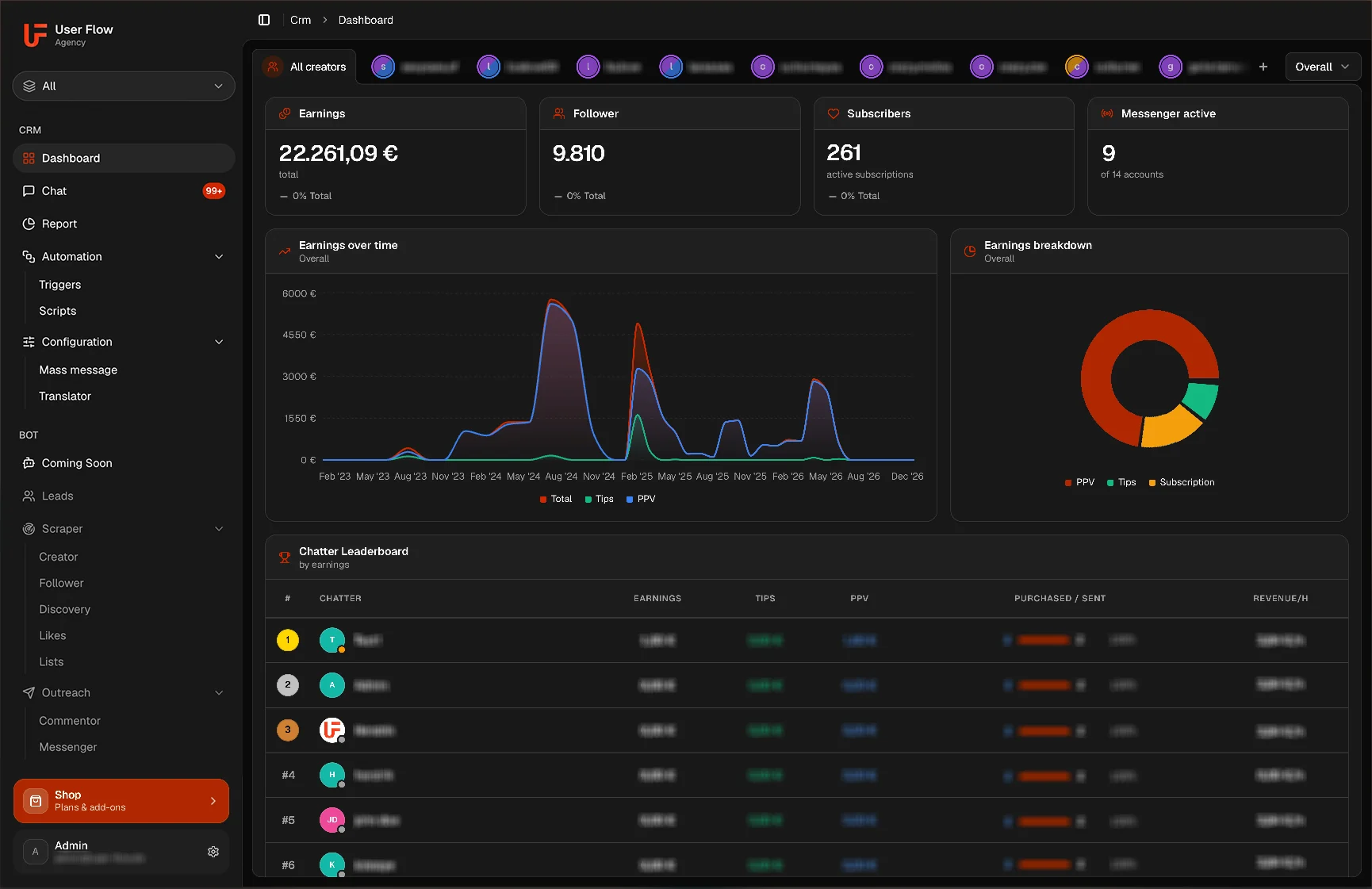
What that view changes in practice is easiest to show side by side:
The four figures that need to sit side by side per creator are few: revenue, PPV conversion rate, chat time spent and subscription trend. Everything else is detail. Miss one of them and you can't answer the decisive question, whether a weak account has a capacity problem or a quality problem.
4Based and Maloum in the same interface
Few agencies stay on 4Based alone. And the moment 4Based and Maloum creators sit alongside each other, the tooling decides whether that becomes a portfolio or two separate operations under one name.
Two systems don't just mean double the upkeep. Above all they leave the most important comparison unanswerable: is an hour of chat currently worth more on one platform than the other? Without that answer you allocate shifts by habit rather than by return, and only notice a shift once it shows up in the monthly result.
That's why in the UserFlow CRM every creator from both platforms sits in the same interface: the same creator bar, the same metrics, the same period. Which parts of your setup actually carry across when running both and which need to be set up per platform is covered in detail in 4Based system: porting it over & running both.
Can you say which of your creators returned the most per hour of chat time over the last 30 days, across both platforms, without adding anything up by hand? If not, the portfolio view is what's missing.
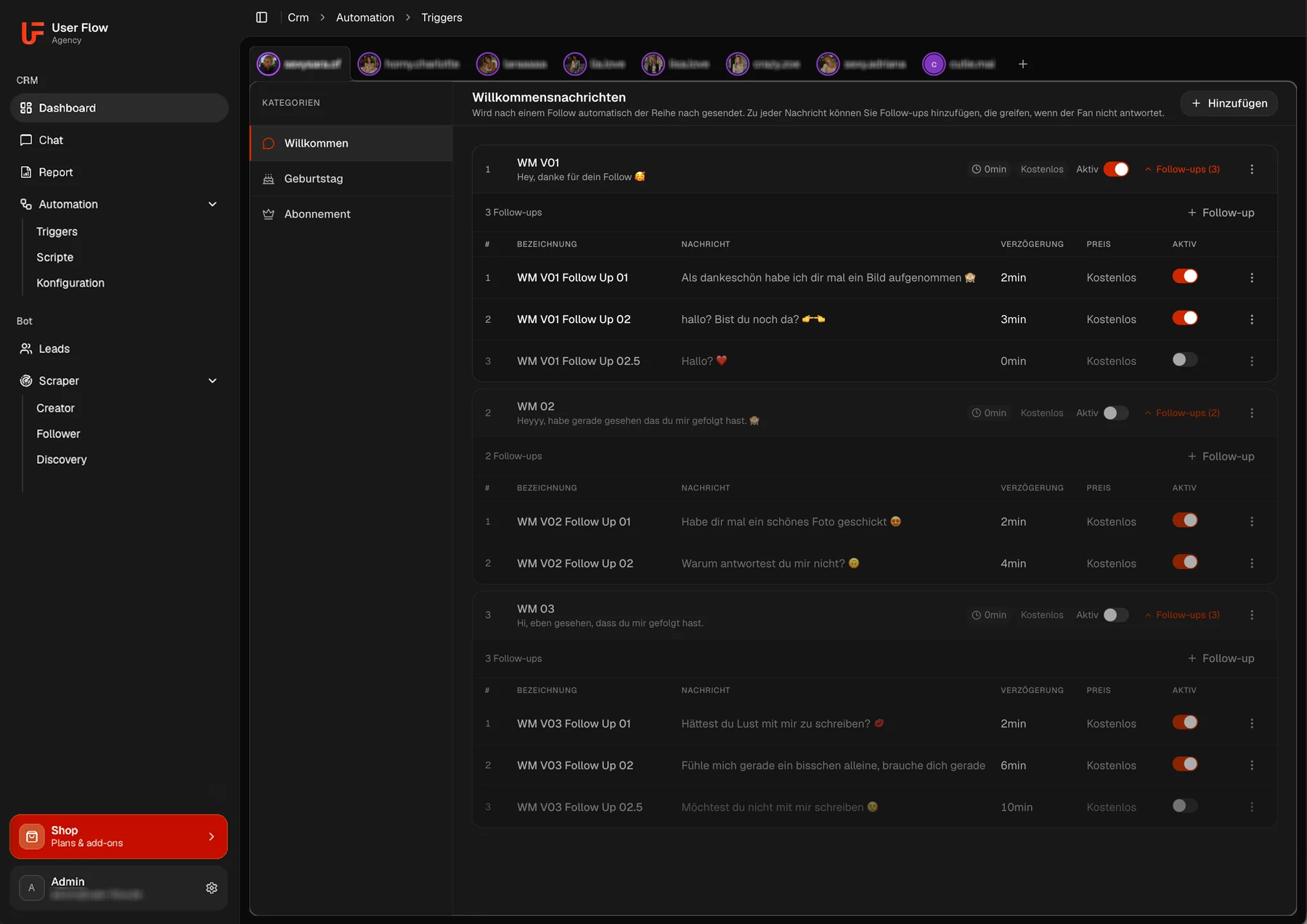
Every creator. Both platforms. One interface.
Revenue, conversion rates and chatter performance per creator side by side, instead of six reports that can't be compared.
- Switch creators with a click, context comes along
- Maloum & 4Based in the same dashboard
- Chatter performance across every account
Allocating attention instead of splitting it evenly
The most common response to a growing portfolio is equal treatment: every creator gets the same number of shifts, the same content support, the same attention. It feels fair and it's the most expensive way to run a portfolio.
Because creators aren't equal, and their differences aren't only size. An account with a high conversion rate and low volume deserves more chat time. An account with high volume and a weak conversion rate doesn't deserve more staff, it needs better messaging. Both look similar in a revenue list and call for opposite measures.
- Strong conversion, little time. The clearest case for more shifts, extra capacity pays off immediately here.
- Plenty of time, weak conversion. Not a capacity problem, a chat problem. More staff only amplifies the mistake; scripts and training are what help, see Maloum PPV: the 3 mistakes.
- Both weak, but new. Needs time, not a verdict. Set a deadline instead of re-litigating it every week.
- Both weak, and not new. The uncomfortable case. This is where you decide whether to free capacity up or keep tying it down.
The point isn't to play creators off against each other. The point is that limited chat time is a resource you either allocate deliberately or let get distributed by default. Not deciding is still a decision, it just goes by volume of complaint.
Bringing a new 4Based creator online
Here's how you spot an agency that thinks in portfolios: the tenth 4Based creator costs less effort than the third. Not because there's less to do, but because the order is settled. Four steps, the same every time:
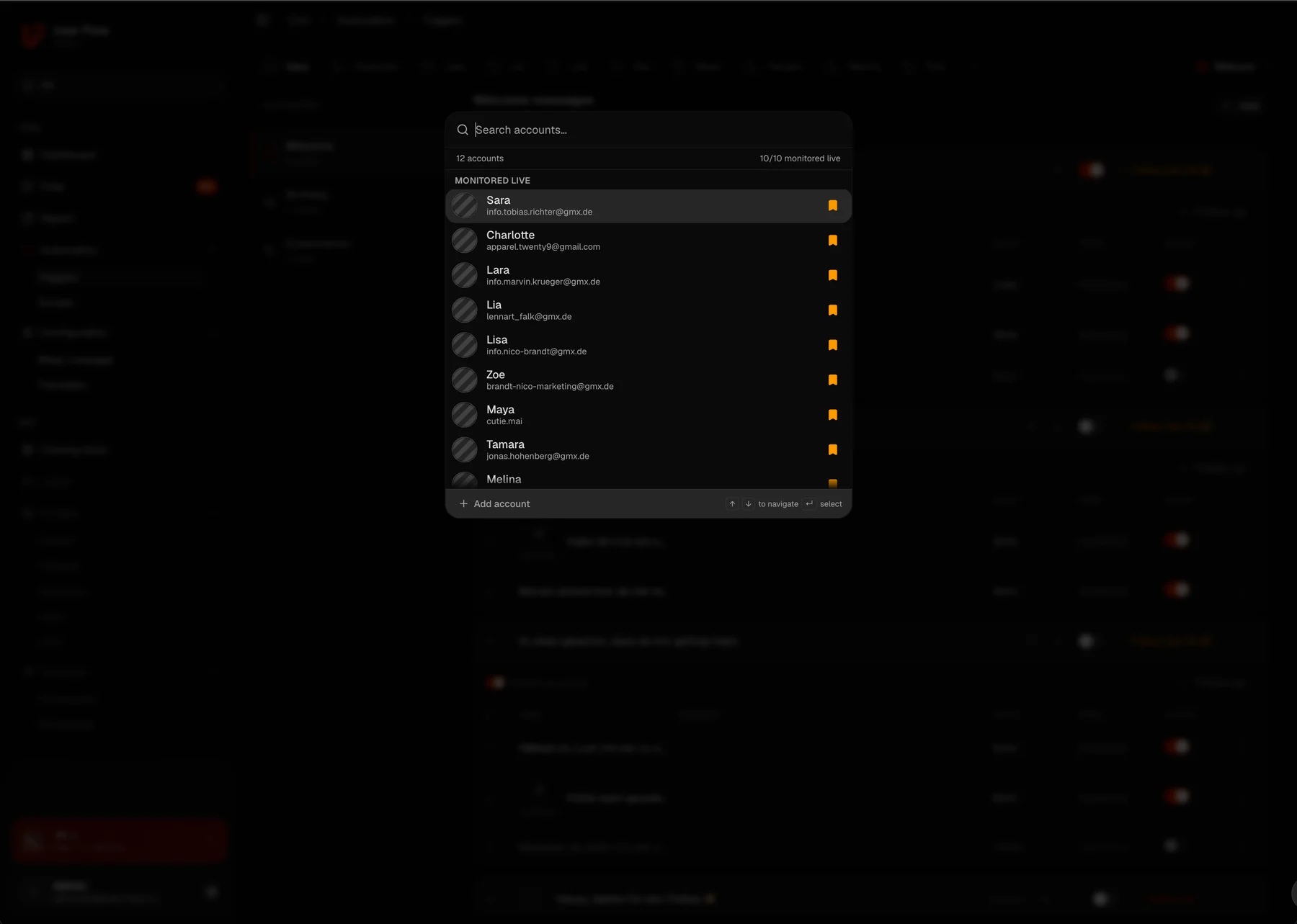
Create the account and pull it into the shared view
Before anything else happens, the creator shows up in the same dashboard as everyone else. Otherwise you create exactly the special case you'll never recover later, the one account nobody has numbers for.
Set up the persona and the scripts
Tone, limits, price level and a script folder for this creator. That's the part that stays specific per account, and the only reason a chatter can credibly serve several creators without blurring them together.
Fill the content folder and set the cadence
Visibility from day one, not from the first quiet afternoon. How to automate that is covered in Maloum auto-posting and for the other platform in 4Based auto-posting.
Assign shifts and set a deadline
Define up front how you'll know in four weeks whether it's working. Without that, every new creator turns into a standing topic, because nobody can say when they're allowed to be judged.
Pull every creator into one view, both platforms included. Compare four metrics instead of six reports. Allocate chat time by return rather than by fairness. And make bringing a creator online four fixed steps instead of a project.
Frequently asked questions
How do I manage several 4Based creators?
Through a shared interface where every creator sits side by side showing the same metrics over the same period. In the UserFlow CRM that's the creator bar for switching, a dashboard across all accounts, and chatter performance per creator. What matters isn't the number of reports but that they're comparable.
Can I manage 4Based and Maloum creators together?
Yes. Both platforms run in the same system, with the same metrics side by side. That's the precondition for moving capacity to wherever an hour of chat currently returns more. What carries across platforms and what needs setting up per platform is covered in its own article.
At how many 4Based accounts do I need a system?
Practically from the third, at the latest from the fifth. With two accounts you can still keep the overview in your head. From three you start needing to compare them; from five the real steering work begins, and without a shared view the agency is run by whoever speaks up.
Which numbers do I need per 4Based creator?
Four cover most decisions: revenue, PPV conversion rate, chat time spent and the subscription trend. Only together do they show whether a weak account is getting too little capacity or using it badly.
How do I assign chatters across several 4Based accounts?
By return rather than evenly, and with an eye on the distance between personas. Two creators with a similar tone are far easier to run in parallel than two opposites. How many accounts one chatter realistically carries is covered in Managing multiple Maloum accounts.